

Trans-Planckian Sensitivity of the Hawking Derivation
A Hawking packet of modest frequency at late retarded time has an exponentially blueshifted precursor when propagated back toward the collapsing body. That kinematic fact identifies a sensitivity question, not its answer: the low-energy spectrum is stable only within a declared class of short-distance dynamics and regular initial states. This page separates the exact blueshift from conditional robustness and from genuinely ultraviolet-dependent claims.
Required background. Radiation from gravitational collapse supplies the late-time ray map; Hadamard short-distance structure states the regularity imposed on the initial field state; and EFT breakdown diagnostics distinguishes a large traced-back frequency from a demonstrated loss of predictive control.
Helpful background. Adiabaticity and Stokes phenomena supplies the mode-conversion test, and controlled effective-field-theory expansions clarifies what must be matched when high-frequency operators are changed.
Exponential ancestry of a late packet
Section titled “Exponential ancestry of a late packet”Let be retarded time at future null infinity and the affine advanced coordinate from which an outgoing ray originated at past null infinity. For regular collapse to a nonextremal horizon,
A phase therefore has precursor frequency with respect to
Finite changes from to a freely falling local frame do not remove this exponential growth. If is the frequency fixed by the affine normalization, a scale is reached after
The conclusion is precise but limited: arbitrarily late packets probe arbitrarily short precursor wavelengths in the relativistic fixed-background derivation. It does not follow that the Hawking ratio is wrong, nor that it is universal under arbitrary ultraviolet changes. Hawking’s original calculation fixes the relativistic result, while Jacobson’s cutoff analysis made the missing short-distance hypothesis explicit (Hawking 1975, §§ 2–3; Jacobson 1991, §§ II–IV).
The structure map locates the sensitivity exactly. It enters between the state-and-collapse input and the near-horizon mode relation; the later greybody problem cannot repair an invalid precursor calculation.

Location of the trans-Planckian question in the Hawking construction. The diagram is schematic and not to scale; exponential ancestry concerns the precursor step, whereas transmission and renormalized flux remain separate calculations.
The failure map should be applied by varying ultraviolet dynamics and the initial state independently. A result that survives one dispersion law but not an excited initial population is state-conditional, not universal.
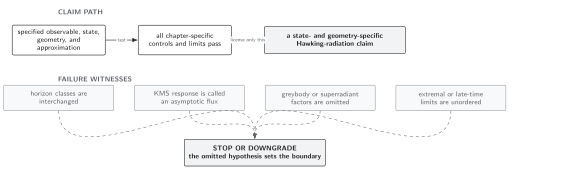
Stopping rule for short-distance robustness. This schematic, not-to-scale map downgrades the claim at the first uncontrolled state, dispersion, boundary, or late-time assumption.
What a robustness argument must control
Section titled “What a robustness argument must control”A useful local model introduces a preferred freely falling frame with velocity and a dispersive comoving frequency ,
The relativistic theory has . A superluminal test law might use
with . This is a controlled model only after four further data are supplied:
- the preferred frame in which and are defined;
- the high- initial state, normally the adiabatic ground state for the incoming positive-norm branch;
- all real and complex roots, their Klein–Gordon norm signs, and their boundary conditions;
- a frequency window separated from both the infrared packet width and the dispersive scale.
Under suitable analyticity, ground-state, adiabaticity, and scale-separation hypotheses, broad classes of dispersive models reproduce the leading low-frequency Hawking ratio. Unruh and Schützhold also constructed counterexamples when those hypotheses are relaxed, so their result is conditional rather than a universality theorem (2005, §§ II–V). A 2024 analysis likewise finds robustness for a monotone class but late-time amplitude sensitivity for certain nonmonotone laws and interior boundary data (Akhmedov et al. 2024, abstract and §§ III–V). These are controlled field models; neither establishes the ultraviolet dynamics of gravity.
Application: trace, modify, and compare one wavepacket
Section titled “Application: trace, modify, and compare one wavepacket”Choose a normalized outgoing packet centered at with and if a narrow thermal bin is desired. Back-propagate its central ray using and record
Here and denote full edge-to-edge widths of a packet window. Equivalently,
when only the fractional frequency width is small. The first reported number states whether the central relativistic precursor crosses ; the edge ratio prevents it from hiding a wide ultraviolet tail. In particular, a frequency-narrow packet with necessarily spans an exponentially broad precursor-frequency range, so a single central ultraviolet scale is insufficient.
Now compute the mode connection twice: once with , once with the superluminal law above, using the same , packet, low- normalization, incoming adiabatic state, and asymptotic scattering potential. Extract and by the conserved norm. The quantities to compare are
Agreement of with tests the near-horizon temperature ratio. Agreement of additionally tests normalization and extra channels. Agreement of requires the same exterior scattering problem. Report convergence as , packet-width dependence, root count, norm conservation, and sensitivity to the ultraviolet boundary condition. No model-independent coefficient of the first correction should be quoted unless it has been derived for the specified and state.
Adversarial test: ancestry is neither failure nor proof
Section titled “Adversarial test: ancestry is neither failure nor proof”Repeat the comparison after placing a smooth occupation on the high- incoming branch. Stimulated terms then modify the outgoing population even if the dispersion relation is unchanged. Next keep the adiabatic ground state but replace the monotone by a nonmonotone law that adds turning points or couples to an interior sector. Either change can alter the amplitude or spectrum.
The strongest surviving statement is therefore:
For a regular collapse state and a specified class of adiabatic ultraviolet propagation laws with , the low-frequency near-horizon Hawking relation can be insensitive to microscopic details over a controlled time and frequency window.
Dropping the regular-state condition removes the vacuum-production interpretation. Dropping adiabaticity permits order-one mode conversion. Dropping restrictions on the dispersion and its boundary data removes the robustness conclusion. Exponential ancestry alone supplies none of these missing premises.
Domain and failure conditions
Section titled “Domain and failure conditions”See the chapter domain and failure-conditions table. This page treats a free or linearized field on a fixed collapse background with a nonextremal peeling interval. It does not compute quantum-gravitational dynamics, self-consistent evaporation, or an astrophysical detection. Evidence was checked through 10 August 2026: the robust statement above is supported by analytic calculations in controlled models, while unrestricted ultraviolet universality remains an open inference.
Exercise
Section titled “Exercise”For a packet with , show how much later its center may arrive before its precursor frequency grows by a factor .
Solution
Because ,
Thus . The result is independent of the packet’s affine normalization; that normalization fixes only the starting frequency.
Related topics
Section titled “Related topics”Modified dispersion and analogue horizons turns this diagnostic into an explicit two-law mode-conversion calculation and states what analogue evidence can and cannot establish.
References
Section titled “References”- Akhmedov, Emil T., Tin-Long Chau, Pei-Ming Ho, Hikaru Kawai, Wei-Hsiang Shao, and Cheng-Tsung Wang. “UV Dispersive Effects on Hawking Radiation.” Physical Review D 109 (2024): 025001. doi:10.1103/PhysRevD.109.025001.
- Brout, Robert, Serge Massar, Renaud Parentani, and Philippe Spindel. “Hawking Radiation without Trans-Planckian Frequencies.” Physical Review D 52 (1995): 4559–4568. doi:10.1103/PhysRevD.52.4559.
- Corley, Steven, and Ted Jacobson. “Hawking Spectrum and High Frequency Dispersion.” Physical Review D 54 (1996): 1568–1586. doi:10.1103/PhysRevD.54.1568.
- Hawking, Stephen W. “Particle Creation by Black Holes.” Communications in Mathematical Physics 43 (1975): 199–220. doi:10.1007/BF02345020.
- Jacobson, Ted. “Black-Hole Evaporation and Ultrashort Distances.” Physical Review D 44 (1991): 1731–1739. doi:10.1103/PhysRevD.44.1731.
- Unruh, William G., and Ralf Schützhold. “Universality of the Hawking Effect.” Physical Review D 71 (2005): 024028. doi:10.1103/PhysRevD.71.024028.