

Causal, Thermodynamic, and Stability Constraints
A quantum state can satisfy an energy inequality yet fail to be passive, or have causal correlators yet destabilize a self-consistent geometry. ANEC, passivity, retarded support, the generalized second law (GSL), and linear-response stability are independent necessary tests with different observables and hypotheses. Applying all five is useful; replacing them by a single label is not.
Required background. ANEC fixes the complete null observable; the generalized second law fixes horizon entropy monotonicity; and semiclassical linear-response stability fixes the causal pole criterion.
Helpful background. Quantum interest supplies duration–separation constraints, passivity and work supplies the cyclic-work criterion, and relativistic causality supplies local commutator support.
Five distinct consistency tests
Section titled “Five distinct consistency tests”Fix a stationary background with Killing generator , a renormalized state , and—when gravity responds—a self-consistent solution. The following questions use different data.
Passivity. For a cyclic unitary operation generated by a perturbation that is switched off at the beginning and end, a passive state obeys
No positive work can be extracted in one cycle. Complete passivity demands this for arbitrarily many copies; under the standard operator-algebraic hypotheses, completely passive states are ground or KMS states (Pusz and Woronowicz 1978, Theorems 1.1 and 1.4). Passivity is defined relative to a dynamics and allowed operations, not by the sign of .
Causal response. With the site source convention , a source changes an observable through
including the contact terms required by Ward identities. Retarded support forbids response outside the causal future. It does not determine the sign of an averaged stress or guarantee bounded response.
Achronal ANEC. For a complete, achronal, affinely normalized null geodesic in a theorem-covered state and geometry,
This constrains one nonlocal stress observable. It does not imply passivity, because a spatially localized cyclic operation is not the same observable, and it does not constrain all poles of a stress-response kernel.
Generalized second law. On an applicable causal horizon with ordered cuts,
when lies to the future of . The entropy includes the geometric counterterms paired with the matter entropy. The GSL is a horizon statement; in a horizonless setup it is not a test that has been “passed.”
Linear-response stability. After gauge and constraints are removed, every physical retarded response mode within the EFT domain must remain bounded over the claimed interval. With an convention, an upper-half-plane pole is a growing mode. A mode at the cutoff is a breakdown warning rather than automatically a new particle.
The structure map joins these tests only at the final consistency decision. None is an algebraic consequence of the other four.

Five consistency questions for stationary semiclassical physics. The diagram is schematic and not to scale; each branch uses a different observable, domain, and failure criterion before their conclusions are compared.
Stationary-state application
Section titled “Stationary-state application”A reproducible assessment proceeds as follows.
- Specify the Hamiltonian or Killing evolution and the algebra of allowed cyclic operations. Test the eigenvalue ordering of or, in algebraic QFT, the passivity inequality.
- Compute retarded—not time-ordered or in-out—correlators and verify causal support and the appropriate Ward identities.
- Identify every null curve used in ANEC, including completeness, achronality, affine normalization, convergence, state, boundaries, and field-theory domain.
- If a causal horizon exists, evaluate the renormalized on ordered cuts. If none exists, record the GSL as inapplicable rather than favorable evidence.
- Linearize the coupled mean equation, supply compatible state perturbations, quotient gauge directions, impose constraints, and search for growing poles below a declared EFT cutoff.
For equilibrium QFT, these tests can reinforce one another. KMS analyticity constrains spectral functions, relative entropy can prove horizon monotonicity, and causality underlies several ANEC derivations. But the proofs still require distinct translations. Hartman, Kundu, and Tajdini, for example, derive ANEC from causality in a unitary Lorentz-invariant QFT under their flat-space assumptions; the result is not the statement that every causal retarded kernel on a curved background obeys ANEC (Hartman, Kundu, and Tajdini 2017, §§ 2–4).
Similarly, a stationary expectation value need not describe stable semiclassical gravity. The retarded inverse response
may have a physical zero with . Anderson, Molina-París, and Mottola formulate the absence of such gauge-invariant, low-energy growth as a necessary validity test for a semiclassical solution (Anderson, Molina-París, and Mottola 2003, §§ II and V). Mean stability still does not control stress fluctuations.
An adversarial four-pass, one-fail model
Section titled “An adversarial four-pass, one-fail model”Logical independence can be exposed with a controlled composite toy model. Put a Hadamard KMS field in a stationary reflecting exterior with a regular Killing horizon, and add a decoupled two-level subsystem with energies . Let its stationary density matrix be diagonal but inverted:
Assume the localized subsystem has nonnegative null stress and is sufficiently weak that its fixed-background and linear-response effects are perturbative. Then, within this deliberately limited model:
- the field’s retarded correlators retain causal support;
- the complete-null stress receives no negative contribution, so the stated ANEC test passes;
- all one-particle and detector poles remain on the real axis with the retarded prescription, so there is no growing low-energy mode;
- stationarity and zero horizon flux make constant, saturating the applicable GSL;
- passivity fails, because a unitary that swaps the two levels lowers the mean energy.
The extractable work is
This toy example is not a macroscopic backreacted construction. Its purpose is sharper: four favorable answers cannot substitute for the fifth. Coupling the detector strongly to the field would change stationarity, flux, poles, and entropy production and would require all five tests again.
One can construct the opposite pattern as well. A KMS state is completely passive and has causal correlators, yet a coupled gravitational channel may exhibit an EFT-controlled instability if the background sits at a thermodynamic or dynamical saddle. Passivity of the matter state alone does not prove stability of the state–geometry pair.
The failure map records exactly which conclusion is lost when a check is omitted or applied outside its domain.
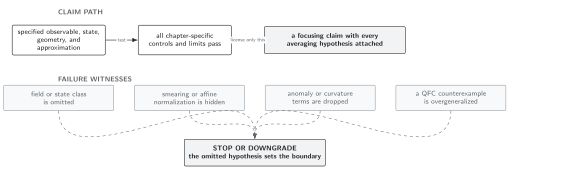
Failure map for combined constraints. The diagram is schematic and not to scale; a state may pass four well-posed tests and fail the fifth, and an inapplicable test supplies no affirmative evidence.
Domain and failure conditions
Section titled “Domain and failure conditions”See the chapter domain and failure-conditions table. The five-part workflow assumes that each observable exists in a common renormalized state and that its own geometric and dynamical hypotheses hold. The toy model assumes weak coupling, a regular stationary horizon state, positive added null stress, and a stable finite-dimensional spectrum. It demonstrates logical independence, not the existence of a fully backreacted black-hole solution.
Exercise
Section titled “Exercise”For a two-level system with and diagonal probabilities , determine the passivity condition.
Solution
The only unitary capable of reducing the energy more than phase rotations is the level swap. Before and after that swap,
Their difference is
No work can be extracted precisely when : populations must not increase with energy. This one-copy condition is passivity; complete passivity is stronger.
References
Section titled “References”- Anderson, P. R., C. Molina-París, and E. Mottola. “Linear Response, Validity of Semiclassical Gravity, and the Stability of Flat Space.” Physical Review D 67 (2003): 024026. DOI.
- Hartman, T., S. Kundu, and A. Tajdini. “Averaged Null Energy Condition from Causality.” Journal of High Energy Physics 2017, no. 7 (2017): 066. DOI.
- Pusz, W., and S. L. Woronowicz. “Passive States and KMS States for General Quantum Systems.” Communications in Mathematical Physics 58 (1978): 273–290. DOI.
- Wall, A. C. “A Proof of the Generalized Second Law for Rapidly Changing Fields and Arbitrary Horizon Slices.” Physical Review D 85 (2012): 104049; erratum 87 (2013): 069904. DOI.