

Noether-Charge Entropy and Higher-Curvature Terms
For a diffeomorphism-invariant local action, stationary black-hole entropy is a Noether charge evaluated on a bifurcation surface. The formula automatically includes the higher-curvature couplings generated by matter loops, but its cleanest theorem concerns stationary bifurcate Killing horizons; dynamical cuts require additional prescriptions and carry ambiguities.
Required background. Generalized-entropy renormalization fixes the couplings, gravitational coupling renormalization supplies the effective action, and variational Noether theory supplies the current. Helpful background. Review field redefinitions, Riemann curvature, and surface-charge ambiguities.
Entropy from the Noether charge
Section titled “Entropy from the Noether charge”Let the covariant Lagrangian -form be . Its variation has the form
For a vector field , the Noether current is
and on shell . On a bifurcation surface , and . Normalizing the Euclidean rotation to period , the standard source convention yields
This expression applies directly to a Lagrangian with no derivatives of curvature; the general formula contains the corresponding Euler derivative. Here . The site’s curvature is related by , so
This crosswalk is essential: the site Einstein–Hilbert coefficient is negative, while the translated entropy is positive Wald 1993, pp. R3428–R3430.
The charge is defined only up to standard covariant-phase-space ambiguities: adding an exact form to , shifting by an exact form, or shifting by an exact form. On a compact bifurcation surface, with and a fixed action including its boundary terms, the stationary entropy and first law are protected from the dangerous pieces. Away from a Killing horizon, terms built from extrinsic curvature can survive; this is why a dynamical entropy functional cannot be inferred from the stationary formula alone.
First application: a curvature-squared theory
Section titled “First application: a curvature-squared theory”Consider the controlled example
For a stationary bifurcate horizon with constant on ,
The correction is dimensionless because is. In a Ricci-flat solution it vanishes for this operator, although independent and terms can contribute according to their binormal contractions. This illustrates why “area entropy” is shorthand for the entropy functional derived from the renormalized action.
As a check, set : the translated site formula gives . Next take a constant-curvature solution; the correction depends only on the scalar curvature evaluated on , as expected for an action. A calculation that instead yields a sign change under the source-to-site curvature translation has mixed action and Riemann conventions.
The stationary first law follows by integrating the variational identity between the horizon and infinity,
for perturbations satisfying the linearized equations and fixed boundary conditions Iyer and Wald 1994, §§III–VI, pp. 851–860.
The structure map places this entropy functional between the renormalized action and later first-law or QES variations.

Higher-curvature entropy is determined by the action’s curvature derivative and horizon binormal, with Einstein area as one special term. Schematic; not to scale.
Domain and failure conditions
Section titled “Domain and failure conditions”The domain table distinguishes this stationary construction from dynamical entropy laws. Required data include the complete renormalized action, boundary terms, field variables, binormal convention, Killing normalization, and admissible variations.
Adversarial test. Add a total derivative or perform a local metric field redefinition, then evaluate a proposed entropy on a nonstationary cut while keeping the old formula. The action and equations can be physically equivalent while the off-stationary local expression shifts by an ambiguity. On a regular bifurcation surface the Noether-charge prescription and first law are invariant under the allowed transformations; away from stationarity one must fix a dynamical entropy prescription and include flux/ambiguity terms.
Matter loops make this issue practical rather than optional: renormalization generates precisely the higher-curvature operators whose Noether entropies cancel surface divergences in . The same renormalized action must therefore govern the field equation, stationary charges, replica variation, and generalized entropy.
The failure map therefore places “dynamical Wald entropy” behind an extra-assumption branch.
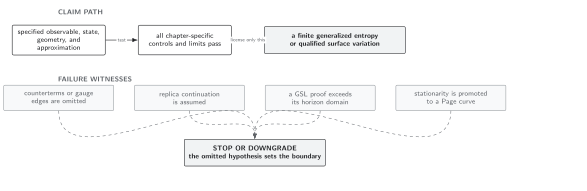
Stationary bifurcation-surface entropy is controlled; an off-stationary extension requires a declared ambiguity prescription and flux law. Schematic; not to scale.
References
Section titled “References”- Iyer, V., and R. M. Wald, “Some Properties of Noether Charge and a Proposal for Dynamical Black Hole Entropy,” Physical Review D 50, 846–864 (1994), doi:10.1103/PhysRevD.50.846.
- Wald, R. M., “Black Hole Entropy Is the Noether Charge,” Physical Review D 48, R3427–R3431 (1993), doi:10.1103/PhysRevD.48.R3427.