

Renormalization of Gravitational Couplings by Matter Loops
Matter loops require the gravitational background action to contain every local generally covariant term needed to absorb their ultraviolet divergences. This is true even when the metric is never quantized. The resulting running is the matter contribution to gravitational couplings, not a graviton-loop beta function.
Required background. Heat Kernels and the Schwinger–DeWitt Expansion identifies the pole, Seeley–DeWitt Coefficients and Curvature Invariants fixes its curvature polynomial, and Local Counterterms and Subdivergence Structure supplies locality of counterterms.
Helpful background. Local Field Redefinitions and the Equivalence Theorem explains redundant coefficients, and Trace Anomalies and Convention Translation fixes the anomaly basis.
The local gravitational basis
Section titled “The local gravitational basis”In four Euclidean dimensions take
where is related to Newton’s coupling after the Lorentzian–Euclidean sign translation, is Weyl-tensor squared, and is the Euler density. On a closed four-manifold, is topological and , but retaining both terms is useful for local anomalies, dimensional continuation, and boundaries.
For a real scalar with
the residue polynomial is
With the proper-time sign convention used in this chapter,
and carries the opposite pole. The universal coefficient source is Vassilevich 2003, Eqs. (4.26)–(4.28). This single expression displays the cosmological, Newton, Weyl-squared, Euler, , and total-derivative sectors.
First application: matching and scale dependence
Section titled “First application: matching and scale dependence”Write bare and renormalized couplings as
Minimal subtraction chooses to cancel the corresponding coefficient of . Differentiating at fixed bare parameters gives the one-loop matter contribution to . Rather than hiding signs in a beta-function convention, a reproducible result reports the residue vector
in the ordered basis , together with the common real-scalar factor and the pole sign above. A complex scalar doubles it; fermions carry their statistics and spin-bundle coefficients.
At and , the residue vanishes while the and Euler residues remain. The local term is scheme dependent because a finite counterterm shifts it. This separates universal anomaly data from a conventional total derivative.
Field-redefinition adversary
Section titled “Field-redefinition adversary”Consider a local metric redefinition
Applied to the lower-derivative gravitational action, it generates curvature-squared terms proportional to the leading metric equations of motion. Consequently, coefficients of redundant Ricci-based operators move. On-shell amplitudes and consistently transformed observables do not. The residue written above is therefore a basis report, not six independently measurable numbers.
The adversarial check is to perform the redefinition on the classical action, counterterms, and observable variation together. If only the printed loop coefficient is transformed, apparent disagreement results. On a boundary, the induced boundary terms must also be retained. Pure-gravity and ghost loops remain absent throughout.
The structure map places this matching after the local coefficient calculation and before threshold decoupling. Inspect how the same residue can be expressed in different local bases without changing the determinant.

Local matter-loop poles close on the generally covariant gravitational basis; field redefinitions can move redundant coefficients but do not introduce graviton loops. Schematic; not to scale.
Domain and failure conditions
Section titled “Domain and failure conditions”The residue is for one smooth-boundaryless real scalar in the stated Euclidean convention. Boundaries add surface couplings; other spins add bundle and gauge structure; physical threshold running requires a mass-dependent observable. See Domain and failure conditions.
The failure map’s loop-content branch is decisive: adding a metric Hessian or gravitational ghosts changes both field content and gauge dependence, and the result must be reassigned to quantum gravity EFT.
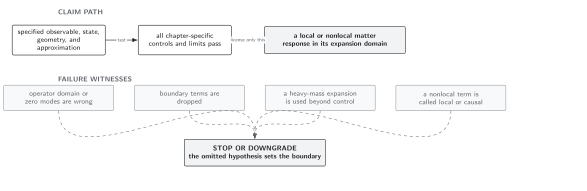
Matter-loop running, pure-gravity running, basis changes, and physical threshold decoupling are distinct statements with distinct inputs. Schematic; not to scale.
Related topics
Section titled “Related topics”Mass Thresholds, Decoupling, and Curvature Expansions converts mass-independent residues into low-energy matching statements. Graviton and ghost contributions belong to One-Loop Graviton EFT.