

When Quantum Gravity Is Needed
A question requiring quantum gravity should be stated precisely enough to compare alternative theories. It must state the exact observable, the approximation that failed, the data and constraints that survive, the error budget at the stopping surface, and the alternatives still compatible with that information.
Required background. Observable-specific validity contracts supplies the target; semiclassical breakdown diagnostics identifies the failed approximation; large-N and species hierarchies supplies cutoff data; singularities and predictive limits supplies boundary uncertainty; evaporation endpoints supplies the information problem; low-energy UV constraints supplies invariant bounds; and limits of interpretation supplies empirical scope.
Helpful background. Quantum extremal surfaces supplies a semiclassical entropy boundary; quasi-de Sitter validity supplies finite-duration limitations; and cosmological-bootstrap status supplies conditional reconstruction constraints.
The minimum scientific package
Section titled “The minimum scientific package”A transfer should answer seven questions in ordinary scientific language:
- What algebraic, relational, detector, entropy, or scattering observable is sought?
- On which spacetime region, state class, resolution, and time interval is it defined?
- Which dimensionless parameter or mathematical construction failed first?
- What is the last stopping surface on which errors are bounded?
- Which conservation laws, anomalies, symmetries, low-energy coefficients, correlators, and theorem hypotheses survive there?
- Which alternative continuations remain compatible with those data, and what observable would distinguish them?
- Does the next task require a microscopic theory, a nonperturbative definition, a rigorous existence theorem, improved numerical control, or simply a higher EFT order?
The distinction in the last question is essential. Failure of a one-loop expansion can call for resummation; failure of a mean equation can call for stochastic gravity; loss of global hyperbolicity can call for boundary or algebraic data; curvature at the gravitational cutoff can call for microscopic input. Only the last case necessarily exhausts the stated low-energy EFT, and even then it does not select a completion.
Low-energy gravity remains an EFT with universal nonanalytic predictions and matched local coefficients below its cutoff Donoghue 1994, §§II–IV, Eqs. (2.1)–(4.13). Those results are constraints on every proposed completion and must travel with the unresolved question.
Two worked transfers
Section titled “Two worked transfers”For an evaporation endpoint, the observable may be the joint late-radiation algebra and its entropy. The package includes the early outgoing state and flux, conserved charges, the semiclassical geometry at , the entropy prescription, factorization assumptions, and the curvature, adiabatic, and fluctuation errors that define . Compatible alternatives may include different endpoint geometries or information-transfer mechanisms. The requested microscopic output is a state and dynamics reproducing the precursor data, not merely a slogan of unitarity.
For a singular initial-condition problem, the observable may be a late correlator conditional on an earlier boundary state. The package includes the last controlled hypersurface, canonical or algebraic data there, low-energy symmetries, anomaly matching, the state class, and the sensitivity to extensions. The requested output is a rule for initial data or continuation with a calculable map to the late correlator. A proposal that gives only a background geometry has not answered the quantum-state question.
These are the page’s first application: two separate packages, because their observables and failed assumptions differ.
The structure map shows controlled inputs converging on a framework-neutral unresolved problem and a discriminating output.

The transfer preserves every controlled precursor result and asks the next theory for a definite observable map, error control, and discriminator rather than allegiance to a framework. Schematic; not to scale.
Remove-the-favorite test
Section titled “Remove-the-favorite test”Delete every sentence naming or presupposing the preferred completion. If the remaining statement still defines the observable, stopping surface, surviving constraints, alternatives, and success test, the transfer is well posed. If it collapses, it was advocacy rather than a scientific problem.
The next theory must also reproduce the appropriate low-energy limit and state why competing solutions fail. A match to one entropy curve or background is insufficient when correlators, causality, anomalies, or conserved charges are part of the package. See the chapter’s domain and failure conditions.
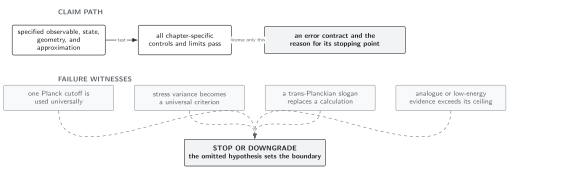
A valid quantum-gravity transfer survives removal of the favored completion and retains a reproducible low-energy target, alternatives, and an observable success criterion. Schematic; not to scale.
References
Section titled “References”- Donoghue, J. F., “General Relativity as an Effective Field Theory: The Leading Quantum Corrections,” Physical Review D 50, 3874–3888 (1994), doi:10.1103/PhysRevD.50.3874.