

Local S-Matrices and Causal Factorization
A local S-matrix is a generating functional for interacting observables with compactly supported couplings. Its decisive property is causal factorization, not the existence of asymptotic particle states. Consequently, perturbative QFT can define local interacting algebras on a globally hyperbolic curved spacetime even when a global scattering matrix or constant-coupling limit is unavailable.
Required background. Curved-space time-ordered products supplies the renormalized multilinear maps, and counterterm locality controls their finite changes.
Helpful background. In–out and in–in expectation values distinguishes a scattering amplitude from a local expectation value, while interacting fields and their limits places the formal construction among other definitions.
Relative S-matrices
Section titled “Relative S-matrices”For a compactly supported local functional , define
If the support of is later than the support of —no point of lies in the causal past of —causal factorization reads
This relation contains ordinary time ordering when the supports are strictly ordered, but it remains meaningful without a global time-translation symmetry.
Choose an interaction with . The relative S-matrix
generates the interacting observable
Only the behavior of in a causal neighborhood of matters to the local algebra. If and agree on a neighborhood large enough to contain the causal influence relevant to a relatively compact region , causal factorization constructs an invertible formal intertwiner between the two sets of observables in . The representatives need not be literally equal; they describe canonically isomorphic local algebras. This is the algebraic adiabatic limit: one removes switching dependence locally without claiming that a single global operator exists (Brunetti and Fredenhagen 2000, §§ 7–8).
The construction map makes causal factorization the bridge between renormalized products and local interacting observables. Inspect the middle box: compact support and relative S-matrices are the construction, while a global adiabatic limit is explicitly a later question.

Role of causal factorization in the interacting construction. This schematic, not-to-scale map separates the locally defined relative S-matrix from the optional and potentially obstructed global switching limit.
The failure map distinguishes two outcomes that are often conflated. Broken causal factorization invalidates the local construction, whereas failure of the infrared limit only removes the corresponding global claim.
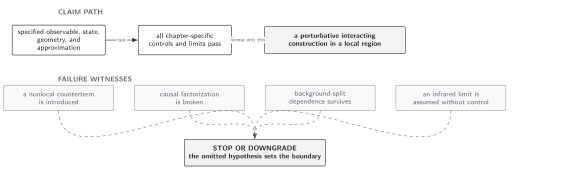
Two different failure boundaries. The map is schematic and not to scale: causal failure stops the local S-matrix, but an uncontrolled adiabatic limit leaves the stabilized local algebra intact.
Application: two compact switching functions
Section titled “Application: two compact switching functions”Let with supported in , and let
where on a causally convex neighborhood of . Write so that is supported to the causal past of and to its causal future; a partition can be chosen after slightly enlarging the neighborhood.
Future changes cancel directly from the retarded observable. Past changes act by conjugation with a relative S-matrix. More explicitly, causal factorization yields a formal invertible element , built from the interaction supported in , such that
Thus the assignment
is an algebra isomorphism on . Composition for three switching functions follows from the same factorization identity, so the result is independent of the chosen decomposition into past and future pieces up to the canonical inner equivalence.
At first order this can be seen from the retarded support property:
A perturbation of entirely to the future of contributes nothing. A past perturbation changes the representative in precisely the way encoded by .
The reproducibility data are the region , supports of , interaction normalization, time-ordered-product prescription, and perturbative order. No vacuum or asymptotic particle interpretation enters the causal check.
Why a failed global limit is not a local failure
Section titled “Why a failed global limit is not a local failure”Take a sequence whose support grows and which equals one on larger compact sets. Vacuum diagrams in can grow with spacetime volume; massless propagators can generate logarithmic or power-law dependence on the switching scale; and a global vacuum-to-vacuum amplitude may have no limit. None of these facts contradicts the local isomorphism above. For any fixed , all sufficiently large have on the needed neighborhood, and the local algebras stabilize up to their canonical identifications.
What survives is a net of formal local interacting algebras and local observables. What does not follow is a global S-matrix, a preferred interacting state, convergence of the formal series, or a state-independent limit of vacuum amplitudes. Those require additional infrared and spectral hypotheses.
Domain and failure conditions
Section titled “Domain and failure conditions”The chapter’s domain and failure-conditions table separates the local and global claims. Compactly supported local functionals, renormalized time-ordered products, global hyperbolicity, and causal factorization license a formal interacting algebra in each relatively compact region, independent of exterior switching up to its canonical isomorphism. The decisive check is the relative factorization identity for arbitrary ordered support changes. If it fails, no local interacting algebra has been established; if only fails, the downgrade is instead to the valid compact/local construction, which provides the starting point for scale, Ward, and infrared analyses.
Checks and limitations
Section titled “Checks and limitations”- Causal factorization must be checked for arbitrary intermediate , not just for a single diagram.
- Compact support is part of the definition at this stage. Setting inside a formal integral before proving an adiabatic limit changes the problem.
- Local algebras are prescription independent only after applying the finite local redefinition associated with a change of time-ordered products.
- On spacetimes with timelike boundary or non-globally-hyperbolic propagation, the causal problem and admissible boundary conditions must first be supplied.
Exercise
Section titled “Exercise”Let be supported strictly to the future of . Show directly from causal factorization that .
Solution
Because is later than , causal factorization gives . Multiplying on the left by yields
Future switching changes therefore cannot affect the retarded interacting observable.
Related topics
Section titled “Related topics”The local construction exists after a renormalization prescription has been chosen. Scaling the metric or subtraction length changes that prescription by finite local terms, producing running matter and curvature couplings.
References
Section titled “References”- Brunetti, Romeo, and Klaus Fredenhagen. “Microlocal Analysis and Interacting Quantum Field Theories: Renormalization on Physical Backgrounds.” Communications in Mathematical Physics 208 (2000): 623–661. doi:10.1007/s002200050004.
- Dütsch, Michael, and Klaus Fredenhagen. “Algebraic Quantum Field Theory, Perturbation Theory, and the Loop Expansion.” Communications in Mathematical Physics 219 (2001): 5–30. doi:10.1007/PL00005563.
- Hollands, Stefan, and Robert M. Wald. “Quantum Fields in Curved Spacetime.” Physics Reports 574 (2015): 1–35. doi:10.1016/j.physrep.2015.02.001.