

States of Low Energy and Smeared-Energy Selection
A state of low energy is selected by minimizing a sampled energy density within a declared class of quasifree states. The sampling function, observer worldline, field, background, and comparison class are part of the definition. Smearing makes the criterion operational and can yield Hadamard states in Robertson–Walker spacetimes, but it does not produce a pointwise energy minimum or a universal vacuum.
Required background. Ground, KMS, and Symmetry-Selected States supplies the stationary limiting case. Hadamard Parametrix and Short-Distance Structure supplies the common ultraviolet subtraction class.
Helpful background. Quantum Energy Inequalities explains why lower bounds are naturally sampled. Localization and Measurement Cost clarifies the physical cost of narrow localization.
The sampled functional
Section titled “The sampled functional”Let be a timelike worldline parametrized by proper time, with unit tangent , and let be real. For Hadamard states in a fixed renormalization prescription, consider
Changing the finite local geometric renormalization terms adds the same state-independent quantity within the comparison class, so it does not change the minimizer. Changing , , or the admissible class generally does.
For the minimally coupled scalar in the standard Robertson–Walker construction, homogeneity decomposes the problem mode by mode. Relative to a normalized reference solution , write
Define
The sampled mode energy is a quadratic function of . Its phase is minimized by opposing , and the squeeze obeys
provided . The minimizing normalized modes define the state of low energy. Nonminimal coupling changes the stress-energy quadratic form and therefore the detailed definitions of and ; it must not be inserted into the displayed minimal-coupling formula by changing alone. Olbermann proved that for smooth compact sampling in the Robertson–Walker setting the resulting state is Hadamard Olbermann 2007, §§ 3–4.
First application: a comoving FLRW observer
Section titled “First application: a comoving FLRW observer”Choose a comoving trajectory, a smooth compactly supported , and a high-order adiabatic reference family . Compute and , construct , and evolve the resulting modes exactly. Compare them with second- and fourth-order adiabatic initial data through their Bogoliubov coefficients.
A defensible report states the scale-factor history on , the mass and coupling used in the stress tensor, the normalization of , the momentum measure, the reference modes, and convergence under increasing adiabatic order and momentum cutoff. The reference family is computational scaffolding: when the construction is implemented consistently, the minimizer is characterized by the sampled functional, not by a preferred instantaneous time.
When is broad in an approximately static epoch, the selected state approaches the stationary low-energy choice in the appropriate sense. For a sampling function centered on a rapidly evolving epoch, it generally differs from an instantaneous ground state because it balances energy over the whole sampling interval.
The narrow-sampling and observer tests
Section titled “The narrow-sampling and observer tests”Replace by and let . Derivatives and high-frequency modes become increasingly important; quantum energy-inequality lower bounds typically scale to negative infinity with an inverse power of Fewster 2012, §§ 2–4. A pointwise lower bound or convergent pointwise minimizer therefore does not follow from the smeared problem.
Changing the observer changes and hence the quadratic coefficients. Even at one event, two worldlines need not select the same state. The adversarial test is to narrow the sampling function or boost the worldline while keeping the original minimizer and boundedness claim. The strongest surviving statement is minimization for the declared and comparison class.
Limits
Section titled “Limits”The explicit modewise construction uses spatial homogeneity. On a general spacetime one needs a separately controlled variational domain and an existence proof. Minimizing over all states is too broad; zero modes, boundaries, and noncompact spatial volume require infrared qualifications. A state of low energy is not automatically a ground state, KMS state, or local energy-density minimizer.
Domain and failure conditions
Section titled “Domain and failure conditions”Smeared-energy minimization is a physical selection rule in the final box of the construction map. The positive Hadamard trial class must be fixed first; the observer and sampling function then distinguish one minimizer within that class rather than defining ultraviolet admissibility.

The minimizer is licensed only after state and Hadamard controls pass and only for the declared worldline, sampling function, and trial class. Schematic; not to scale.
The first box of the failure map requires the observable, geometry, and approximation to be specified. Narrowing the sampling support or changing the worldline changes those data; loss of boundedness or a different minimizer therefore narrows the original claim rather than revealing a universal pointwise state.
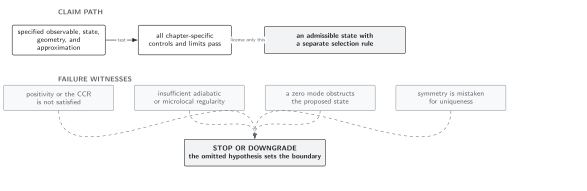
Sampling and observer dependence are defining inputs, and the singular-sampling limit need not preserve the minimizer or lower bound. Schematic; not to scale.
The chapter-wide comparison is in Domain and failure conditions.
Related topics
Section titled “Related topics”Adiabatic States, WKB Order, and Regularity supplies the comparison modes. The stress tensor entering the functional is defined in Renormalized Stress Tensor: Axioms and Curvature Ambiguities. General existence and controlled state construction continue in Existence, Deformation, and Gluing of Hadamard States.
References
Section titled “References”- Fewster, Christopher J. “Lectures on Quantum Energy Inequalities.” 2012. arXiv:1208.5399.
- Olbermann, Heiner. “States of Low Energy on Robertson–Walker Spacetimes.” Classical and Quantum Gravity 24 (2007): 5011–5030. DOI. Open PDF.