

Classical Energy Conditions and Quantum Violations
Classical energy conditions are algebraic assumptions on a stress tensor, chosen to support causal energy flow or geometric focusing. They are not consequences of Hilbert-space positivity. Renormalized quantum stress tensors can violate every pointwise condition, even in controlled states. The parallel-plate Casimir stress makes the distinction explicit and also shows why the observer, null direction, boundary, and finite-renormalization prescription belong in the claim.
Required background. Stress tensors and spacetime charges fixes tensor projections, and renormalized stress-tensor axioms and ambiguities fixes the quantum observable.
Helpful background. The Poincaré spectrum condition explains positive total energy without pointwise positivity, while vacuum polarization and Casimir effects supplies the boundary-state example.
Four pointwise classical conditions
Section titled “Four pointwise classical conditions”In signature , let be future-directed unit timelike and nonzero null. In dimensions:
For continuous classical tensors, DEC implies WEC and WEC implies NEC by a null limit. SEC is a trace-reversed condition and is independent of WEC in general. Through Einstein’s equation, NEC gives , while SEC gives timelike convergence when the cosmological term is treated consistently. These are hypotheses of geometric theorems, not universal laws of matter.
For a renormalized quantum field, write
where the are allowed conserved local curvature tensors and boundary terms require separate treatment. A local sign can therefore depend on the finite prescription unless the geometry makes the ambiguity vanish or the couplings are fixed operationally.
The structure map places pointwise conditions at the start of the chapter, before sampling or entropy variation introduces genuinely different quantum statements.

Pointwise energy conditions as inputs to later focusing arguments. The map is schematic and not to scale; quantum violations motivate averaged or entropy-sensitive statements but do not identify one unique replacement.
Parallel-plate Casimir application
Section titled “Parallel-plate Casimir application”Between ideal perfectly conducting plates separated by proper distance in flat four-dimensional spacetime, away from the plates, the electromagnetic stress in the plate rest frame is
where is normal to the plates. Brown and Maclay derive the stress and its boundary-temperature limits (Brown and Maclay 1969, Eqs. (8)–(12)).
For the static observer ,
so WEC and DEC fail. The electromagnetic stress is traceless in the flat bulk, so SEC reduces to the same timelike projection there and also fails for this observer.
For a null vector with ,
The NEC is violated for every ray with a nonzero component normal to the plates and is saturated for a ray exactly parallel to them. The conclusion is directional; “the Casimir state violates NEC” without the null direction suppresses useful information.
For a boosted observer,
Thus every inertial observer in the idealized bulk sees negative energy density. This does not imply negative total Hamiltonian for the full apparatus: plate stresses, preparation, boundary energy, and the subtraction relative to the no-plate vacuum are part of the physical system.
Scheme and boundary adversarial test
Section titled “Scheme and boundary adversarial test”In the exactly flat bulk, curvature ambiguity tensors vanish, but the constant term shifts even though it drops out of . The Brown–Maclay tensor is the matched plate-minus-no-plate stress with the Minkowski vacuum normalized to zero, so the same constant cancels between the two configurations. In that matched observable, the displayed null and timelike projections are scheme resistant. On a curved background, however, and need not vanish. A claimed small violation must be compared with the allowed finite shift, with the corresponding gravitational couplings translated.
Boundaries add another qualification. Surface counterterms and divergences near idealized sharp plates are not captured by a smooth boundary-free stress theorem. The bulk result at distances large compared with the microscopic plate scale is controlled; extrapolation onto the ideal surface is not.
The failure map marks both missing state/scheme data and overgeneralization from one projection. Pointwise negativity is a counterexample to a classical assumption, not yet a QEI, ANEC, or focusing theorem.
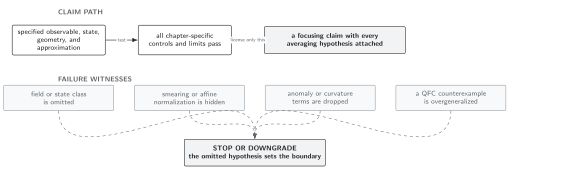
Validity of the Casimir energy-condition test. The diagram is schematic and not to scale; the matched plate-minus-no-plate flat-bulk projections with Minkowski-vacuum normalization are scheme resistant, while curved or surface-local claims require vacuum, finite-curvature, and boundary data.
Domain and failure conditions
Section titled “Domain and failure conditions”See the chapter domain and failure-conditions table. The calculation assumes ideal static plates, the renormalized electromagnetic vacuum, flat bulk geometry, and points separated from the boundaries. It demonstrates pointwise quantum violations, not unrestricted negative total energy, a general interacting-field theorem, or an allowed macroscopic exotic geometry.
Exercise
Section titled “Exercise”Derive from the displayed stress tensor.
Solution
Contracting with the diagonal covariant tensor gives
Using yields .