

Curvature Counterterms and Composite-Operator Mixing
Curvature is not an optional decoration of a flat-space counterterm list. Once short-distance distributions are extended locally on a curved background, every local covariant operator with the required dimension and symmetries can appear. The same principle makes composite operators mix with curvature invariants, even when the metric is nondynamical.
Required background. Curved-space time-ordered products identifies the diagonal ambiguities; counterterm locality supplies their general origin; and operator-mixing matrices gives the basis-change formalism.
Helpful background. Renormalized composite insertions explains source differentiation, while schemes and finite parts separates divergent subtraction from finite normalization.
The four-dimensional local basis
Section titled “The four-dimensional local basis”For a real -even scalar with
power counting through dimension four and general covariance allow
Powers of may be factored from and to make coefficients dimensionless. In four dimensions the Euler density relates one quadratic-curvature combination to a topological term after integration, and is a boundary term for an action on a boundaryless spacetime. They should not be discarded prematurely: local insertions, boundaries, and stress-tensor variations can distinguish terms that an integrated bulk action does not.
These geometric terms are required even if is a prescribed background. Vacuum diagrams and metric variations probe them. Including them does not quantize gravity; it makes the matter effective action and stress tensor renormalizable at the declared order. The curved-space ambiguity classification follows from local covariance and scaling rather than from a special heat-kernel coordinate choice (Hollands and Wald 2001, § 5).
Composite operators mix by quantum numbers and dimension
Section titled “Composite operators mix by quantum numbers and dimension”Couple sources to a basis . Renormalized insertions are derivatives with respect to the renormalized sources, and two prescriptions are related by a local triangular transformation
where can contain local curvature and parameter factors that supply the dimension difference. Tensor type, internal symmetries, ghost number, and conservation laws further restrict the matrix.
For the dimension-two even scalar,
For a dimension-four even scalar, a representative off-shell basis includes
The Riemann-squared term may replace a quadratic-curvature element depending on whether Euler and boundary terms are quotiented out. On shell, the field equation relates , , , , and up to a divergence. A calculation must say whether it uses an off-shell insertion basis, an on-shell quotient, or integrated operators; otherwise two correct mixing matrices can appear inconsistent.
The construction map shows where this basis acts: local curvature counterterms renormalize the causal products and must be correlated with Ward identities before an interacting observable is accepted. Inspect the counterterm box as a constraint, not an optional correction appended after the calculation.

Position of curvature mixing in the controlled construction. The diagram is schematic and not to scale; the local operator basis is fixed by dimension and symmetry, while its finite coefficients require renormalization conditions.
The relevant failure witness is importing a flat counterterm list. In the lower map, that omission behaves as an incomplete renormalization choice: a remaining divergence or Ward mismatch prevents the curved-background claim.
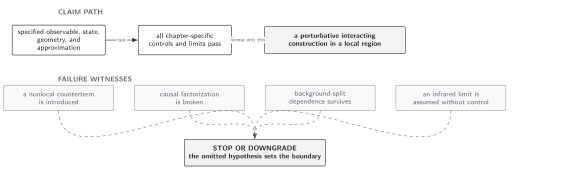
Failure path for an incomplete counterterm basis. This schematic, not-to-scale map shows that finiteness on flat space does not license a locally covariant result on arbitrary curvature.
Application: renormalizing
Section titled “Application: renormalizing ϕ2\phi^2ϕ2”Define a locally covariant Hadamard subtraction at scale ,
At one loop in , the insertion appears in a tadpole and in source-differentiated diagrams. Dimensional analysis and symmetry show that the most general finite redefinition is
with formal series and unless a tree-level normalization sets their constants to zero. A practical scheme can impose, for example, Minkowski vacuum normalization at a reference mass to fix , plus one curved-background condition to fix . Flat-space data alone cannot determine because there.
To see why the curvature term is forced, the first Hadamard coefficient for contains the local combination in the site’s curvature convention. Thus is conformal in four dimensions. Changing the logarithmic scale in the parametrix consequently shifts the coincidence limit by
where the overall constant depends on the normalization of . The operator content, not that convention-dependent constant, is the conclusion. This is the simplest visible instance of curvature mixing.
Adversarial test: importing the flat basis
Section titled “Adversarial test: importing the flat basis”Suppose one renormalizes all flat-space graphs using only and then places the result on a background with . The tadpole or heat-kernel coefficient contains a divergence proportional to . No adjustment of cancels it on arbitrary backgrounds: is constant while varies. Omitting therefore leaves a divergent two-point kernel or, after an inconsistent finite subtraction, a metric-variation Ward identity that fails by a local term.
Likewise, vacuum diagrams generate curvature-only divergences. They can be ignored for normalized nongravitational correlators only if no metric variation is ever taken. The moment the stress tensor or effective gravitational response is claimed, the geometric terms are required.
The strongest result supported by the flat list is a renormalized calculation on flat backgrounds, or on a very restricted fixed-curvature family after parameter degeneracies are stated. It is not a locally covariant theory over arbitrary metrics.
Domain and failure conditions
Section titled “Domain and failure conditions”The shared domain and failure-conditions table gives the chapter-scale comparison. On this page the inputs are spacetime dimension, field content, symmetries, boundary assumptions, and an explicit off-shell, on-shell, or integrated operator basis. They license only counterterms and mixing among local covariant operators of compatible dimension and quantum numbers. Completeness under metric variation is the decisive check. If an or curvature-only divergence remains, the claim is restricted to the backgrounds on which that operator vanishes or is degenerate; only a complete basis can be handed to the local S-matrix and running-coupling analysis.
Checks and limitations
Section titled “Checks and limitations”- Match operator dimensions and all discrete/internal symmetries before calculating coefficients.
- State whether equality is local, integrated modulo divergences, or on shell.
- Vary the metric: every counterterm in the action induces a correlated contribution to the stress tensor.
- Under a finite basis change, transform both Wilson coefficients and operator matrix elements; neither part is separately invariant.
- With a timelike or spatial boundary, add the allowed boundary invariants and boundary conditions. The bulk list above is not complete for that problem.
Exercise
Section titled “Exercise”Why can mix with but not with in a four-dimensional renormalizable scalar theory?
Solution
The engineering dimension of is one, so has dimension two. Both and have dimension two and the same scalar, even quantum numbers. By contrast, has dimension four. Mixing into it would require a coefficient of dimension , such as an inverse mass squared, which violates the polynomial/analytic dependence and scaling assumptions of the renormalizable local prescription. It can occur in a higher-dimension EFT expansion only with its suppression scale declared.
Related topics
Section titled “Related topics”The counterterm basis describes all allowed ultraviolet changes. Local S-matrices now use a chosen prescription to construct observables with compactly supported interactions and show exactly which parts are independent of global scattering assumptions.
References
Section titled “References”- Hollands, Stefan, and Robert M. Wald. “Local Wick Polynomials and Time Ordered Products of Quantum Fields in Curved Spacetime.” Communications in Mathematical Physics 223 (2001): 289–326. doi:10.1007/s002200100540.
- Hollands, Stefan, and Robert M. Wald. “Quantum Fields in Curved Spacetime.” Physics Reports 574 (2015): 1–35. doi:10.1016/j.physrep.2015.02.001.
- Parker, Leonard, and David J. Toms. Quantum Field Theory in Curved Spacetime: Quantized Fields and Gravity. Cambridge: Cambridge University Press, 2009. doi:10.1017/CBO9780511813924.