

Infrared Resummation and Dynamical Mass
Infrared resummation reorganizes a nonuniform expansion; it does not create one method-independent particle mass. A “dynamical mass” may denote an equal-time variance scale, a gap-equation parameter, a late-time decay exponent, or a pole of a retarded correlator. Agreement is meaningful only after those observables and coupling conventions are translated.
Required background. Interacting infrared logs supplies the breakdown parameter; dynamical RG supplies secular reorganization; and large-N saddles supplies the controlled limit. Helpful background. Review massless zero modes and nonuniform large-N corrections.
A declared large-N convention
Section titled “A declared large-N convention”Consider the spectator potential
At leading large , define the per-component coincidence function
The self-consistent mass in this normalization is
For , the leading de Sitter infrared variance is . Hence the massless gap equation gives
The coefficient changes if the quartic coupling or is normalized differently; the scaling is the more portable statement. The mass screens the equal-time infrared enhancement after a relaxation interval of order e-folds.
The same result appears from the leading stochastic equilibrium. Write . The radial probability includes both
and the Jacobian . At large , the radial saddle gives , and substituting in the gap equation reproduces . Omitting the radial measure gives the wrong saddle.
First application: translate three resummations
Section titled “First application: translate three resummations”Compute the late equal-time two-point function in three descriptions: the large-N gap equation, the Euclidean zero-mode integral, and the stochastic stationary distribution. Translate all of them to the potential above and to the same . At leading large , their infrared variance and mass scale agree. Beneke and Moch show how nonperturbative Euclidean zero-mode treatment generates this scaling and how its diagrammatic recovery requires infinitely many graphs Beneke and Moch 2013, §§2–5, Eqs. (10)–(46).
Now compare an unequal-time correlator. Its slowest decay eigenvalue in the Fokker–Planck problem need not equal beyond the Gaussian or leading-large-N limit. A self-energy extracted from a retarded function can also have frequency dependence. Therefore an equal-time match licenses an infrared variance scale, not automatically a common spectral or relaxation mass.
Large-N resummation also organizes vertices and anomalous infrared powers. Serreau and Parentani obtain a nonperturbative large-N resummation of bubble diagrams with explicit ultraviolet renormalization Serreau and Parentani 2013, §§III–VI, pp. 085012-5–085012-16. Its domain is the controlled large-N deep infrared, not arbitrary finite or subhorizon momentum.
The structure map places each method beside the observable it resums. Inspect the convention translation before comparing reported masses.

For the declared normalization, controlled methods reproduce at leading large ; unequal-time and finite-N claims require additional tests. Schematic; not to scale.
Domain and failure conditions
Section titled “Domain and failure conditions”Use the chapter’s domain table. The worked coefficient assumes exact de Sitter, the Euclidean/BD state, minimal coupling, massless bare theory, the displayed convention, leading , and the light infrared approximation. Finite duration may end before the gap relaxes.
Adversarial test. Move to finite , include the first subleading correction, and compare equal-time variance, unequal-time decay, and a retarded response in the same renormalization scheme. Reject a universal mass claim if only agrees or if translating the coupling removes the numerical equality. Also vary the ultraviolet matching scale: surviving dependence beyond the computed order signals incomplete renormalization rather than infrared physics.
The failure map narrows the result to its controlled observable. The matched equal-time sector can pass to stochastic coarse-graining; spectral and response statements require their own real-time calculation.
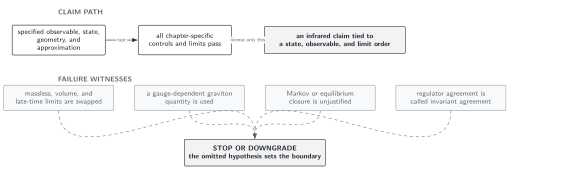
Resummations agree only on translated observables within their expansion parameters; one equal-time variance does not define a universal de Sitter quasiparticle mass. Schematic; not to scale.
References
Section titled “References”- Beneke, M., and P. Moch, “On ‘Dynamical Mass’ Generation in Euclidean de Sitter Space,” Physical Review D 87, 064018 (2013), doi:10.1103/PhysRevD.87.064018.
- Serreau, J., and R. Parentani, “Nonperturbative Resummation of de Sitter Infrared Logarithms in the Large-N Limit,” Physical Review D 87, 085012 (2013), doi:10.1103/PhysRevD.87.085012.