

Vacuum Ambiguity, Time Flow, and Observer Dependence
A generic curved spacetime supplies a field equation and a causal algebra, but not a preferred split into positive- and negative-frequency solutions. A “vacuum” therefore always means a state selected relative to extra structure: a timelike symmetry, an asymptotic region, a choice of modes, a preparation procedure, or an operational probe. Changing that structure can change particle language while leaving the underlying local field algebra untouched.
Required background. Covariant Algebraic Quantization and Fock Realizations supplies the state-independent CCR algebra. Vacua, States, and Representations distinguishes a state from the Hilbert-space representation it induces.
Helpful background. Haag’s Theorem: Physical Meaning and Scope gives a flat-space warning about representation comparisons. One-Particle States reviews the additional Poincaré structure available in Minkowski spacetime.
Positive frequency requires a time flow
Section titled “Positive frequency requires a time flow”In Minkowski spacetime, time translations have a preferred future direction and the spectrum condition selects modes with . On a stationary curved spacetime with complete timelike Killing field , the flow of may similarly define an automorphism group and a positive-energy ground-state condition. On a nonstationary geometry there is generally no conserved generator whose positive spectrum could make that choice.
Even when a Killing field exists, its normalization and domain matter. A stationary observer follows its integral curves only where it is timelike; a rotating generator can become spacelike, and distinct asymptotic ends can define inequivalent notions of incoming and outgoing frequency. The algebraic state is primary. “Particle” is a derived interpretation tied to a chosen one-particle structure or detector protocol, as emphasized in Wald 1995, §§ 2–3.
Inertial and accelerated splittings
Section titled “Inertial and accelerated splittings”For a massless scalar in two-dimensional Minkowski spacetime, a right-moving inertial mode is proportional to , with . In the right Rindler wedge, an accelerated time coordinate satisfies . The same function becomes
which is not a single positive-frequency exponential in . Its Fourier decomposition contains both signs of Rindler frequency. The Minkowski and Rindler positive-frequency subspaces therefore differ, even though both are representations of the same local field algebra in the wedge.
This is the declared comparison: hold the field, commutator, spacetime region, and local two-point observable fixed; change only the time flow used to interpret frequency. The nonzero Bogoliubov mixing is not itself a detector calculation, and the thermal response of an accelerated detector requires the operational analysis developed later. It does show why “empty of Minkowski quanta” and “empty of Rindler quanta” are different assertions.
Instantaneous diagonalization is not a vacuum theorem
Section titled “Instantaneous diagonalization is not a vacuum theorem”On a time-dependent background one can diagonalize a quadratic Hamiltonian on one Cauchy surface. The resulting state depends on the foliation, canonical variables, and chosen time. More seriously, a low-order instantaneous prescription can have incorrect high-momentum behavior. Evolving it may produce a two-point distribution that is not Hadamard, so point-split observables acquire state-dependent ultraviolet divergences.
The adversarial test is therefore twofold:
- compare the candidate’s large-momentum expansion with a Hadamard or sufficiently high-order adiabatic reference;
- evolve the candidate and evaluate a localized detector or renormalized observable only after that ultraviolet test passes.
A rapidly varying scale factor makes the limitation visible: minimizing the instantaneous oscillator energy fixes data at one time but does not control arbitrarily many time derivatives of the frequency. The strongest safe statement is “instantaneous ground state relative to this canonical Hamiltonian at this time,” not “the vacuum.” An explicit counterexample to naive instantaneous positive-energy selection is given in Junker 1996, § 3.5.
What can be invariantly retained
Section titled “What can be invariantly retained”Several statements survive the loss of a preferred vacuum:
- the local algebra and causal commutator are state independent;
- the difference of two Hadamard two-point functions is smooth;
- local observables can be compared after using one consistent renormalization prescription;
- a state may be preferred relative to a declared symmetry, temperature, sampling function, or preparation protocol.
None of these statements makes the preference universal. The locally covariant framework strongly constrains any attempt to choose one state naturally on every spacetime; under standard dynamical-locality assumptions, a nontrivial theory admits no such universal natural state Fewster and Verch 2015, § 6.
Exercise
Section titled “Exercise”Show that rescaling a stationary time coordinate , with , rescales mode frequencies but does not change the positive-frequency subspace.
Solution
A mode becomes . Since , the sign of the frequency is unchanged. The ground-state splitting is the same, but numerical energies and inverse temperatures rescale. A negative or position-dependent rescaling would not represent the same future-directed stationary flow.
Domain and failure conditions
Section titled “Domain and failure conditions”In the construction map, observer-dependent positive frequency belongs at the final selection step, not at the definition of the field algebra. Inspect the separation between the positive state and the rightmost box: inertial and accelerated descriptions can retain the same algebra and local kernel while assigning different particle meanings.

A time flow may select a particle splitting only after statehood and ultraviolet admissibility have been established; the selection is relative to that flow. Schematic; not to scale.
For an instantaneous-vacuum claim, the failure map directs attention to ultraviolet regularity, zero modes, and the unjustified move from symmetry to uniqueness. A failure there narrows “the vacuum” to a state associated with one slice or observer.
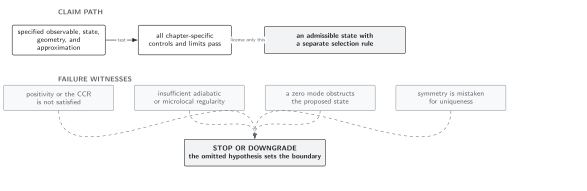
Observer dependence is harmless when declared, but omitted regularity or uniqueness hypotheses invalidate a universal-vacuum claim. Schematic; not to scale.
The chapter-wide comparison is collected in Domain and failure conditions.
Related topics
Section titled “Related topics”Complex Structures and One-Particle Spaces makes frequency splitting geometric on the real solution space. Ground, KMS, and Symmetry-Selected States states the extra hypotheses under which a time flow genuinely selects a state. Operational detector consequences belong to Particles, Detectors, and Nonadiabatic Production.
References
Section titled “References”- Fewster, Christopher J., and Rainer Verch. “Algebraic Quantum Field Theory in Curved Spacetimes.” In Advances in Algebraic Quantum Field Theory, edited by Romeo Brunetti, Claudio Dappiaggi, Klaus Fredenhagen, and Jakob Yngvason, 125–189. Cham: Springer, 2015. DOI. Open PDF.
- Junker, Wolfgang. “Hadamard States, Adiabatic Vacua and the Construction of Physical States for Scalar Quantum Fields on Curved Space-Time.” Reviews in Mathematical Physics 8 (1996): 1091–1159. INSPIRE record.
- Wald, Robert M. “Quantum Field Theory in Curved Spacetime.” 1995. arXiv:gr-qc/9509057.