

Topology, Zero Modes, and Global Sectors
Local curvature controls local wave propagation, but topology controls which global solutions and observables exist. Compact Cauchy surfaces create discrete spectra and constant modes; noncontractible cycles support holonomies and fluxes; gauge theories can acquire centers or superselection sectors. These features must be separated from ultraviolet singularities and from ordinary nonzero-momentum modes.
Required background. Local Field Algebras, Causality, and the Time-Slice Property supplies the observable assignment.
Helpful background. Differential Forms, Integration, and Stokes’ Theorem supplies cohomology and cycle pairings; Operator Algebras and Positive Functionals supplies centers and sectors.
Local equations and global solution spaces
Section titled “Local equations and global solution spaces”The differential expression
is local. Its space of global solutions is not. On an ultrastatic spacetime , scalar modes satisfy
with a spectrum determined by and its boundary conditions. A zero eigenvalue requires separate treatment because formulas containing become singular.
For a massless minimally coupled scalar on a compact connected , the spatially constant mode has an effective action
It is a free particle, not a harmonic oscillator. Consequently there is no normalizable stationary oscillator ground state for that mode. Removing it, compactifying the scalar, giving it a mass, or choosing a nonstationary wave packet defines different theories or states and must be declared.
Gauge fields add cohomological sectors. A flat Abelian connection can have nontrivial Wilson loops
around noncontractible one-cycles even though locally. Magnetic fluxes pair with two-cycles. Quantization may turn such global observables into central elements or sector labels, depending on which observables and gauge transformations are admitted.
First application: sphere versus torus
Section titled “First application: sphere versus torus”Compare and .
For a scalar on a round of radius , the Laplacian eigenvalues are
On a flat cubic of side ,
Both compact spaces have a constant scalar mode, but their nonzero spectra and degeneracies differ. For wavelengths much shorter than or , local singular structure agrees with the corresponding local geometry; the infrared state space does not.
For Maxwell theory the contrast is sharper:
whereas
The torus has three independent flat holonomies and three magnetic-flux directions; the sphere has neither. A local polarization count sees two propagating photon polarizations in both cases and misses this entire global sector.
Fewster and Lang show that the universal free Maxwell theory can violate locality in the presence of nontrivial topology because cohomological observables enter the radical and center; a reduced theory removes the relevant degeneracies but also changes which global observables are retained Fewster and Lang 2015, §§3–6. “Universal” and “reduced” are therefore different global constructions, not two gauges for an identical algebra.
Adversarial same-curvature test
Section titled “Adversarial same-curvature test”Compare ordinary Minkowski spacetime with a flat spacetime whose spatial sections are a large torus. Inside a diamond smaller than the identification scale, the regions are isometric: the metric, curvature, local field equation, and short-distance singularity all agree. Globally, only the torus has compact-cycle holonomies, quantized fluxes, and a discrete momentum spectrum.
The test sorts claims by support. A local measurement confined to the common diamond can be transported by local covariance. A statement about a Wilson loop around the torus, the scalar zero-mode ground state, or the center of the global algebra cannot. If a calculation based only on local curvature claims to determine those global quantities, it has exceeded its domain.
Superselection sectors add a further distinction. Local observables may be unable to connect states carrying different global flux. A convex mixture across sectors is not equivalent to a coherent superposition made possible by enlarging the observable algebra. The chosen global algebra must be stated before sector probabilities are interpreted.
Construction and failure maps
Section titled “Construction and failure maps”In the construction map, inspect the note beneath the algebraic stage: topology can change the algebra before a state is selected. This is the central point of the sphere–torus comparison.

Topology modifies the solution space and observable algebra before state-dependent expectation values are evaluated; the construction map is schematic and not to scale.
In the failure map, the decisive witness is an ignored zero mode or degeneracy. Passing all local curvature checks does not remove that failure.
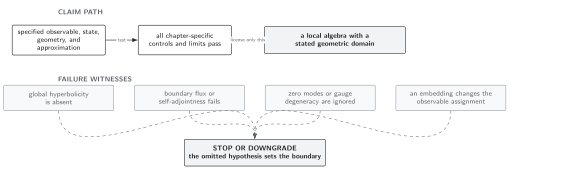
Global conclusions require the topology, zero-mode treatment, and observable algebra to be stated; otherwise only a local or nonzero-mode result is licensed. Schematic and not to scale.
The common comparison appears in Domain and failure conditions. For topology-sensitive claims, the page-specific checks are the relevant cohomology groups, kernels of spatial operators, allowed large gauge transformations, flux lattice, and center of the chosen algebra.
Check your understanding
Section titled “Check your understanding”Why does adding a small mass repair the scalar zero-mode oscillator formula on a compact slice?
Solution
The constant mode acquires frequency (modified by any constant curvature coupling), so its action contains both and . It becomes a harmonic oscillator with a normalizable ground state. The limit is infrared singular and cannot be obtained by blindly substituting into every ground-state covariance.
Timelike Boundaries, Self-Adjoint Extensions, and AdS Boundary Conditions treats the other principal source of global data. Cohomological theorems remain in Volume I and full superselection-sector theory in Volume XVI.
References
Section titled “References”- Marco Benini, Claudio Dappiaggi, and Alexander Schenkel, “Quantized Abelian Principal Connections on Lorentzian Manifolds,” Communications in Mathematical Physics 330 (2014), 123–152, DOI, arXiv:1303.2515.
- Christopher J. Fewster and Benjamin Lang, “Dynamical Locality of the Free Maxwell Field,” Annales Henri Poincaré 17 (2016), 401–436, DOI, arXiv:1403.7083.
- Bernard S. Kay, “The Principle of Locality and Quantum Field Theory on (Non Globally Hyperbolic) Curved Spacetimes,” Reviews in Mathematical Physics, special issue (1992), 167–195, DOI.