

Boundaries, Surface Counterterms, and Boundary Stress
A smooth boundary changes the ultraviolet problem. Bulk Hadamard subtraction removes the ordinary coincidence singularity, but reflected short paths generate boundary-local divergences and flux terms. Renormalization therefore requires the boundary condition, normal orientation, surface counterterms, and boundary stress to be specified together.
Required background. Renormalized Stress Tensor: Axioms and Curvature Ambiguities supplies the bulk tensor; Timelike Boundaries and AdS Boundary Conditions supplies the well-posed field problem; Boundaries, Flux, and Boundary Ward Identities supplies the flux identity.
Helpful background. Wick Polynomials and Hadamard Point Splitting supplies the interior subtraction; Counterterms, Subdivergences, and Locality explains local surface renormalization.
Robin data and surface geometry
Section titled “Robin data and surface geometry”Let be a smooth timelike boundary. Choose the outward spacelike unit normal
and define using this declared normal. For a scalar, a local Robin condition is
where the boundary field has mass dimension one. Dirichlet is treated as a separate limiting boundary problem; it is not obtained by blindly setting a numerical Robin coefficient to infinity inside every renormalized expression.
For a Laplace-type Euclidean continuation, the heat trace has the short-time form
with
The half-integer coefficients are purely boundary contributions, while integer coefficients can have both bulk and surface pieces. The are local polynomials in , , intrinsic boundary curvature, pulled-back bulk curvature, and normal derivatives. McAvity and Osborn derive the boundary DeWitt expansion and its geometric data McAvity and Osborn 1991, §§2–5, pp. 606–628.
In four dimensions the divergent and finite surface action can therefore contain, schematically,
with appropriate powers of or supplying dimension three. The ellipsis includes the remaining invariants allowed by dimension, symmetries, and the chosen boundary problem. Bulk curvature counterterms cannot replace these independent coefficients.
Boundary stress and the Ward identity
Section titled “Boundary stress and the Ward identity”Use the page-local variations
For a tangential diffeomorphism and a boundary without corners,
in the declared outward-normal convention, with background-force and anomalous terms added when present. The right side is the tangential momentum delivered by the bulk. A normal displacement instead probes the shape response and normal pressure; a fixed external wall may supply the balancing force.
Corners, null segments, and boundary-condition-changing interfaces contribute additional localized data. The smooth-boundary formula is not silently extended across them.
First application: stress near a Robin wall
Section titled “First application: stress near a Robin wall”For and Robin data , split the two-point function into
The first term is the usual local Hadamard singularity. becomes singular when approaches the wall because the reflected geodesic shrinks. If is proper distance to a smooth boundary, dimensional analysis permits a leading four-dimensional stress behavior
For finite Robin parameter , its dimensionless short-distance combination is , so it normally first affects subleading coefficients; the leading term depends on the boundary universality class and curvature coupling. An exceptional scaling defines a different boundary limit and must be analyzed separately. The coefficients also depend on the field and state. A surface counterterm renormalizes the integrated effective action and boundary distribution; it need not make the idealized pointwise bulk stress finite as .
A controlled calculation separates:
- the bulk Hadamard subtraction at fixed ;
- boundary-local heat-kernel coefficients and their finite prescription;
- the surface stress ;
- the interior conservation law;
- the tangential bulk–boundary Ward identity;
- the normal force or shape derivative.
The general boundary heat-kernel coefficient structure and Robin dependence are tabulated in Vassilevich 2003, §§5.2–5.4, pp. 326–337.
Adversarial bulk-only subtraction
Section titled “Adversarial bulk-only subtraction”Subtract only and approach the wall. The remaining powers of or a mismatch between and cannot be canceled by tuning a bulk coefficient: their support and geometric dependence are different.
The strongest result away from the wall is an interior renormalized stress at fixed . A claim about total energy, wall force, or the boundary limit requires the allowed surface action and Ward identity. If the microscopic wall has finite thickness, the ideal boundary result also needs matching to that material scale.
Boundary and failure maps
Section titled “Boundary and failure maps”The structure map gains a separate surface branch: reflected singularities and boundary heat-kernel data meet the bulk tensor only in the total Ward identity.

Bulk stress, surface stress, tangential flux, and normal force are distinct pieces of one bounded system; the map is schematic and not to scale.
The failure map shows why a finite interior tensor cannot certify a boundary observable.
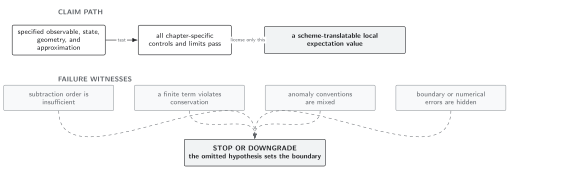
A bulk-only prescription stops at positive distance from the boundary and cannot be exported as a wall force; the map is schematic and not to scale.
Use Domain and failure conditions. State boundary regularity and causal type, outward normal, sign, field boundary operator, state, proper distance, bulk and surface counterterms, corner data, tangential flux, normal force, and microscopic boundary scale.
Null-Projected and Smeared Stress Observables treats distributional smearing. Chapter 1 develops existence and well-posedness of the boundary field theory; Volume III develops general boundary Ward identities; Volume XVI develops rigorous boundary constructions.
References
Section titled “References”- David M. McAvity and Hugh Osborn, “A DeWitt Expansion of the Heat Kernel for Manifolds with a Boundary,” Classical and Quantum Gravity 8 (1991), 603–638, DOI.
- Dmitri V. Vassilevich, “Heat Kernel Expansion: User’s Manual,” Physics Reports 388 (2003), 279–360, DOI, arXiv:hep-th/0306138.