

Averaged Null Energy in Curved Spacetime
The averaged null energy condition (ANEC) is a sign condition on the stress integrated over an entire null generator. Its strongest applications normally require a complete achronal geodesic, convergence of the integral, a fixed affine normalization, and a field/state domain supplied by a particular theorem. ANEC is not a long-duration timelike QEI, and it need not constrain a finite null segment.
Required background. Curved-spacetime QEIs explains why the null limit is distinct, and ANEC supplies flat-space and information-theoretic formulations.
Helpful background. Relativistic causality supplies achronality; null-smeared stress observables supplies the distributional observable; and half-sided inclusions gives one algebraic route to null positivity.
Complete achronal null averages
Section titled “Complete achronal null averages”Let be an affinely parametrized null geodesic with tangent . ANEC is
The numerical value is normalization dependent. Under ,
so the sign is invariant for . Completeness means that the affine parameter covers the entire inextendible generator. Achronality means that no two points on can be joined by a timelike curve. These are geometric hypotheses, not synonyms for “long.”
The integral also needs a definition. One may take a limit of smooth cutoffs and prove that the result exists and is independent of the admissible cutoff family. Conditional convergence without a prescribed limiting procedure is insufficient.
In Minkowski-space QFT, ANEC has broad proofs, including interacting theories under standard assumptions via modular Hamiltonians (Faulkner et al. 2016, §§ 2–4). Curved-spacetime achronal ANEC statements require extra geometric, field, and self-consistency assumptions; there is no rule that transfers every flat theorem to every complete curved null geodesic.
The structure map places completeness, achronality, affine scale, state, and limiting procedure before the sign conclusion.

Data entering an ANEC statement. The map is schematic and not to scale; a complete achronal integral is a different observable from a finite null segment or a boosted timelike average.
Free-field wavepacket check
Section titled “Free-field wavepacket check”Consider a free massless scalar in four-dimensional Minkowski spacetime, with the vacuum stress normalized to zero, and a normalized one-particle wavepacket
Let be its positive-frequency wavefunction. Along a complete null line ,
up to the standard normalization of . Therefore
provided the derivative is square integrable. Record the wavepacket normalization, the null tangent, and convergence of cutoff integrals
This example is a direct controlled calculation, not a proof for arbitrary states or curved backgrounds. Squeezed states can have negative on finite intervals while retaining a nonnegative complete average in domains where ANEC holds. Fewster and Roman exhibit precisely the distinction between failure of a null-smeared QEI and survival of ANEC in their state family (Fewster and Roman 2003, §§ III–IV).
Incomplete and chronal adversarial curves
Section titled “Incomplete and chronal adversarial curves”Truncate the generator to . The finite integral
can be negative because compensating positive stress may lie outside the interval. ANEC supplies no contradiction. Likewise, a null geodesic that wraps through a compact direction or reflects from a boundary can be chronal or fail to be a single complete affinely parametrized generator. Boundary conditions alter both the state and the stress observable.
The correct downgrade is:
- complete, achronal, convergent, theorem-covered curve: apply ANEC;
- finite segment: report the finite null average without an ANEC sign;
- incomplete or chronal curve: seek a theorem that explicitly covers it;
- reflecting boundary: include boundary hypotheses and surface terms.
The failure map makes withdrawal, rather than extrapolation, the required response.
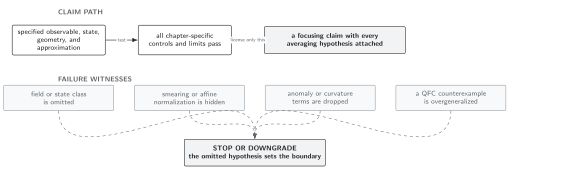
ANEC validity test. The diagram is schematic and not to scale; a negative finite segment can coexist with a nonnegative complete average, while an out-of-domain curve carries no inherited sign.
Domain and failure conditions
Section titled “Domain and failure conditions”See the chapter domain and failure-conditions table. The wavepacket calculation uses a free scalar, a finite-particle Hadamard state, Minkowski-vacuum subtraction, a complete achronal null line, and square-integrable null derivative. Curved ANEC, interacting theories, boundaries, and gravitational backreaction require their own hypotheses.
Exercise
Section titled “Exercise”Show that the sign of is invariant under every orientation-preserving affine rescaling.
Solution
With , , one has and . Hence
Multiplication by the positive number preserves the sign.
References
Section titled “References”- Faulkner, T., R. G. Leigh, O. Parrikar, and H. Wang. “Modular Hamiltonians for Deformed Half-Spaces and the Averaged Null Energy Condition.” Journal of High Energy Physics 2016 (2016): 38. DOI.
- Fewster, C. J., and T. A. Roman. “Null Energy Conditions in Quantum Field Theory.” Physical Review D 67 (2003): 044003; erratum 80 (2009): 069903. DOI.
- Graham, N., and K. D. Olum. “Achronal Averaged Null Energy Condition.” Physical Review D 76 (2007): 064001. DOI.