

Acceleration, Gravity, and the Limits of Equivalence-Principle Arguments
The equivalence principle permits a local comparison between freely falling frames and inertial frames, and between supported laboratories and accelerated laboratories over sufficiently small regions. It does not identify quantum states, global horizons, curvature, detector histories, or switching protocols. A detector response is nonlocal in proper time, so matching proper acceleration at one event cannot force two responses to agree.
Required background. Unruh Effect and Uniformly Accelerated Detectors supplies the acceleration result; Curved Spacetimes, Cauchy Surfaces, and Global Hyperbolicity supplies global causal distinctions.
Helpful background. Detector Response Along Curved and Accelerated Worldlines supplies the response functional; Vacuum Ambiguity, Time Flow, and Observer Dependence supplies state dependence.
What can be matched locally
Section titled “What can be matched locally”At one event on a timelike worldline, choose an orthonormal frame. In a freely falling frame the connection can be set to zero at that event, but curvature cannot. Over a laboratory of linear size ,
A supported observer has proper acceleration
One can match to a Rindler trajectory at the event. This fixes local kinematics through a limited order. It does not match the full worldline, geodesic separation between all pairs of sampled points, or the field state’s smooth two-point part.
The detector response contains a double integral over its history:
For duration , curvature corrections can scale as , while jerk and higher trajectory derivatives produce their own dimensionless parameters. The state-dependent smooth part of can differ at zeroth order in these local curvature estimates.
First application: matched acceleration, different curvature
Section titled “First application: matched acceleration, different curvature”Compare:
- a uniformly accelerated hyperbola in Minkowski spacetime and the Minkowski vacuum;
- a static trajectory in a curved stationary spacetime, matched to have the same at one event, with a declared stationary state.
For sufficiently short smooth switching, their Hadamard singular parts agree at leading local order. Corrections separate into:
An especially clear check uses de Sitter spacetime. In the invariant de Sitter state, a geodesic detector has but a thermal response at
while an inertial Minkowski detector with the same has zero excitation rate in the vacuum. For a stationary accelerated de Sitter trajectory, the response can combine curvature and acceleration through
in the ideal invariant-state setting. Deser and Levin derive this embedding-space relation for de Sitter detectors Deser and Levin 1997, pp. L163–L168. It is not a universal formula for arbitrary curved spacetimes or states.
Adversarial state and horizon changes
Section titled “Adversarial state and horizon changes”Keep the same worldline and acceleration but replace the field state. The response changes because changes. Or keep the local metric and acceleration fixed while changing the global boundary or horizon structure; reflected correlations and available stationary states can change.
Thus equal acceleration does not imply equal response, temperature, particle number, or flux. The strongest equivalence-principle statement is a local short-distance comparison with errors controlled by curvature radius, detector duration and size, trajectory derivatives, and state matching. Horizon thermality and asymptotic flux require global arguments.
Construction and failure maps
Section titled “Construction and failure maps”The structure map shows where the equivalence comparison enters: geometry, state, and complete detector worldline precede the response.

Matching acceleration at one event controls only part of the detector construction; curvature, state, and causal history remain independent. Schematic and not to scale.
The validity map identifies the central failure witness: acceleration evaluated as though it were curvature erases tidal and global information.
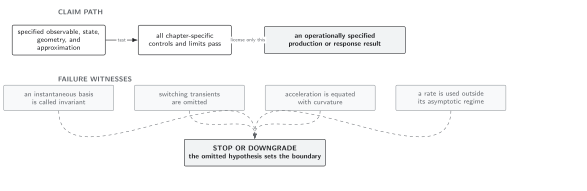
The equivalence principle licenses a controlled local comparison, not universal equality of quantum response or radiation; the map is schematic and not to scale.
Use Domain and failure conditions. Report acceleration, curvature invariants and radius, detector size and duration, jerk, state matching, switching, boundary or horizon data, and the first or finite-size correction.
Check your understanding
Section titled “Check your understanding”Why is a geodesic detector in de Sitter a decisive counterexample to “temperature depends only on proper acceleration”?
Solution
Its proper acceleration is zero, yet in the invariant de Sitter state its stationary response is thermal at . An inertial detector in the Minkowski vacuum also has zero acceleration but zero excitation rate. Curvature, state, and global stationary structure supply data that acceleration alone omits.
General relativity develops the geometric equivalence principle; Chapter 6 develops actual horizon radiation. This page develops only the operational QFT comparison and its error domain.
References
Section titled “References”- Luis C. B. Crispino, Atsushi Higuchi, and George E. A. Matsas, “The Unruh Effect and Its Applications,” Reviews of Modern Physics 80 (2008), 787–838, DOI, arXiv:0710.5373.
- Sóstenes Deser and Orit Levin, “Accelerated Detectors and Temperature in (Anti-)de Sitter Spaces,” Classical and Quantum Gravity 14 (1997), L163–L168, DOI, arXiv:gr-qc/9706018.
- Jorma Louko and Alejandro Satz, “Transition Rate of the Unruh–DeWitt Detector in Curved Spacetime,” Classical and Quantum Gravity 25 (2008), 055012, DOI, arXiv:0710.5671.