

The Generalized Second Law: Hypotheses and Proven Scope
The generalized second law (GSL) states that a jointly renormalized generalized entropy does not decrease toward the future along specified causal horizons. It is proved in important semiclassical domains, but not for every surface called a horizon, every interacting QFT, or arbitrary higher-curvature gravity.
Required background. Generalized-entropy renormalization fixes the finite quantity; relative entropy in QFT supplies monotonicity; and the semiclassical Einstein equation relates stress to geometry. Helpful background. Review quantum energy inequalities and passivity.
Statement and theorem domain
Section titled “Statement and theorem domain”Let be a future causal horizon and a cut of its null generators. With the outside algebra and state declared, define
For cuts ordered so that lies nowhere to the past of , the GSL is
Wall’s arbitrary-slice proof applies to semiclassical quantum fields crossing a causal horizon, minimally coupled to general relativity, assuming a horizon observable algebra with Determinism, Ultralocality, Local Lorentz Invariance, and Stability. The axioms are verified there for free fields of several spins and for -dimensional conformal field theories; extensions to general interacting theories remain conditional Wall 2012, §§2–5, especially Eqs. (6)–(13).
This theorem permits rapidly changing fields and comparisons of arbitrary horizon cuts within its axioms. It does not require a quasi-static flux. The word “causal” is essential: a causal horizon is a global null boundary, whereas an apparent or trapping horizon depends on a foliation and need not generate nested exterior algebras of the required kind.
Why relative entropy gives monotonicity
Section titled “Why relative entropy gives monotonicity”The proof strategy selects a reference state whose horizon restriction is thermal with respect to null dilations. Its modular Hamiltonian is a weighted null-energy operator. The area term, via the semiclassical Einstein and Raychaudhuri equations with suitable future boundary data, supplies the complementary modular-energy contribution. Consequently differs from minus a relative entropy by a cut-independent constant:
Moving the cut to the future restricts the accessible algebra. Relative entropy decreases under restriction, so increases. This is a structural proof: renormalized entropy, the horizon algebra, the reference-state modular flow, and gravitational constraint all enter.
First application: perturb a stationary causal horizon
Section titled “First application: perturb a stationary causal horizon”Begin with a stationary horizon and a state regular on it. Specify a perturbation whose backreaction remains semiclassical, define the outside algebra on every cut, use one renormalization scheme for and , and require the future boundary condition used to relate area to boost energy. If the horizon algebra obeys the four axioms, monotonicity applies even when the incoming field changes rapidly. For a free scalar, the construction is within the verified field class; for an arbitrary interacting nonminimally coupled theory, it is a proposed extension until the algebraic and renormalization hypotheses are established.
The structure map shows the proof’s dependencies. Inspect how the algebraic inclusion and geometric constraint meet only after generalized entropy is renormalized.

The proved GSL combines algebraic monotonicity with horizon modular flow and the semiclassical gravitational constraint in a specified field class. Schematic; not to scale.
Domain and failure conditions
Section titled “Domain and failure conditions”The chapter’s domain table distinguishes this theorem from first laws and QES stationarity. Record horizon type, cuts, algebra, state regularity, field class, coupling to gravity, renormalization, and perturbative order.
Adversarial test. Replace the causal horizon by a foliation-dependent apparent horizon. Its outside regions need not form the nested algebras used in the proof, and jumps of the marginally trapped surface can occur. The Wall theorem therefore cannot be invoked. A separate quasi-local entropy proposal or restricted theorem may exist, but it must be proved with its own evolution and regularity hypotheses.
The failure map identifies this as a domain substitution, not a counterexample to the causal-horizon GSL.
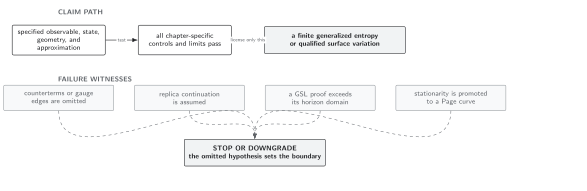
The GSL theorem is strong within its causal-horizon and horizon-algebra domain; differently defined horizons require independent analysis. Schematic; not to scale.
References
Section titled “References”- Wall, A. C., “A Proof of the Generalized Second Law for Rapidly Changing Fields and Arbitrary Horizon Slices,” Physical Review D 85, 104049 (2012), doi:10.1103/PhysRevD.85.104049.