

Analogue and Phenomenological Evidence Ceilings
Analogue experiments and astrophysical observations can test real quantum kinematics, mode conversion, correlations, propagation, and effective coefficients. Their evidential reach stops where the map to a gravitational observable introduces untested dynamics, source modeling, or microscopic assumptions. This page states durable ceilings using results available through 10 August 2026.
Required background. Observable-specific validity contracts supplies the measured quantity and tolerance; cross-regime trans-Planckian sensitivity supplies robustness classes; modified dispersion and analogue horizons supplies the laboratory map; and analogue and astrophysical claim limits supplies channel-specific evidence boundaries.
Helpful background. Long-distance quantum-gravity corrections supplies EFT observables, while bubble sources and gravitational-wave propagation supplies source-transfer uncertainties.
The evidence ladder
Section titled “The evidence ladder”For an analogue horizon, distinguish five steps:
- calibrated laboratory observables such as density correlations or photon counts;
- reconstruction of mode frequencies, norms, occupations, and partner correlations;
- validation of an effective metric and dispersion map for the perturbations;
- demonstration of Hawking-type kinematic mode conversion within that medium;
- inference about gravitational backreaction, black-hole thermodynamics, or microscopic quantum gravity.
Experiments can strongly support steps 1–4 while leaving step 5 open. Bose–Einstein-condensate measurements reported a correlation spectrum consistent with a thermal analogue temperature set by surface gravity Muñoz de Nova et al. 2019, Abstract and Figures 3–4, and subsequent measurements tested stationarity over several times Kolobov et al. 2021, Abstract and Figures 2–4. These are substantive tests of quantum field kinematics in a controlled dispersive medium; the condensate does not obey Einstein’s equation.
Two 2026 optical results extend the laboratory menu. A heralded single photon stimulated a measured analogue Hawking frequency conversion with sub-Poissonian output statistics Felipe-Elizarraras et al. 2026, Results, Figures 5–7. A separate experiment measured backreaction of stimulated optical analogue radiation on its effective field Procopio et al. 2026, Abstract and Figures 3–5. Because both are stimulated and medium specific, neither is a direct observation of spontaneous astrophysical Hawking radiation or gravitational backreaction.
Astrophysical propagation bounds
Section titled “Astrophysical propagation bounds”Gravitational-wave observations constrain parameterized generation and propagation models. A modified dispersion relation may be written
and event populations bound after waveform, calibration, population, cosmology, and source assumptions are included. The published GWTC-3 tests found no evidence for the tested dispersion, polarization, or post-merger deviations and reported posterior bounds within those parameterizations LIGO–Virgo–KAGRA 2025, Abstract and dispersion analysis. This constrains an EFT or phenomenological coefficient; it is not a detection of quantum spacetime and does not constrain UV effects that do not map into the tested waveform family.
The first application traces one analogue spectrum and one propagation bound from raw measured quantity to the strongest conclusion. At each arrow list calibration, nuisance model, transfer function, theoretical map, and alternatives. The conclusion stops at the first unsupported arrow.
The structure map makes this evidence ladder and its two distinct branches visible.

Analogue and astrophysical evidence constrain calibrated kinematics and parameterized propagation; gravitational dynamics and microscopic completion require additional, independently tested mappings. Schematic; not to scale.
Broken-map adversarial test
Section titled “Broken-map adversarial test”In the analogue case, alter the dispersion or destroy the effective horizon while preserving a possible nuisance emission mechanism; the Hawking interpretation must weaken at the map step. In the astrophysical case, vary the source population and waveform systematics; the propagation bound must broaden accordingly. A conclusion that does not respond to its nuisance assumptions is overstated.
Record null results, systematic uncertainties, correction history, and data provenance as part of the evidence, while keeping the scientific conclusion conventional and specific. See the chapter’s domain and failure conditions.
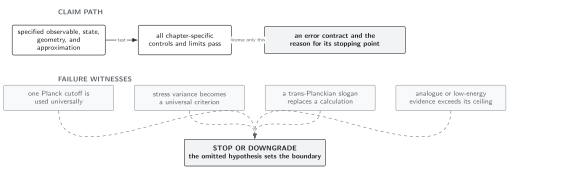
Evidence is downgraded at the exact calibration, mapping, nuisance, or transfer step that fails; successful analogue kinematics or EFT bounds are not relabeled as direct quantum-gravity detection. Schematic; not to scale.
References
Section titled “References”- Felipe-Elizarraras, R., H. Cruz-Ramirez, K. Garay-Palmett, A. U’Ren, and D. Bermudez, “Measurement of Analogue Hawking Radiation Stimulated by a Single Photon,” Nature Communications 17, 7012 (2026), doi:10.1038/s41467-026-73812-8.
- Kolobov, V. I., K. Golubkov, J. R. Muñoz de Nova, and J. Steinhauer, “Observation of Stationary Spontaneous Hawking Radiation and the Time Evolution of an Analogue Black Hole,” Nature Physics 17, 362–367 (2021), doi:10.1038/s41567-020-01076-0.
- LIGO Scientific Collaboration, Virgo Collaboration, and KAGRA Collaboration, “Tests of General Relativity with GWTC-3,” Physical Review D 112, 084080 (2025), doi:10.1103/PhysRevD.112.084080.
- Muñoz de Nova, J. R., K. Golubkov, V. I. Kolobov, and J. Steinhauer, “Observation of Thermal Hawking Radiation and Its Temperature in an Analogue Black Hole,” Nature 569, 688–691 (2019), doi:10.1038/s41586-019-1241-0.
- Procopio, L. M., R. Aguero-Santacruz, D. Bermudez, and U. Leonhardt, “Backreaction of Stimulated Hawking Radiation in an Optical Analogue,” Nature 655, 336–341 (2026), doi:10.1038/s41586-026-10720-3.