

Influence Functionals, Dissipation, and Noise
The influence functional explains why stochastic gravity contains both a noise kernel and a causal matter-response kernel. They are different components of one closed-time-path calculation: the imaginary quadratic form admits a stochastic representation when it is positive, while the real branch-mixing term changes the deterministic response. Neither component may be dropped merely because the other is known.
Required background. The Stress-Tensor Noise Kernel fixes the covariance normalization; In-In Effective Actions and Causal Mean Backreaction fixes causal variation; and System–Environment Splits and Influence Functionals supplies the general reduced-density-matrix construction.
Helpful background. Noise, Dissipation, and Fluctuation Relations separates symmetric and retarded kernels, while Schwinger–Keldysh Actions for Open QFT develops average/difference variables.
Two histories and two kernels
Section titled “Two histories and two kernels”Start with a matter operator coupled as ; abbreviates indices and spacetime position. The matter state is specified on the initial Cauchy surface. After tracing out matter, the influence functional is
Define
Unitarity gives and . To quadratic order about , and suppressing local contact terms, these identities organize the action as
With the displayed plus source coupling,
Changing the sign of the source coupling changes the response convention, but not the symmetric covariance. For a covariant metric perturbation, , the site stress convention gives ; hence set before varying. Keeping this factor is necessary to recover the Einstein equation with source .
The structural map emphasizes that and rejoin only in the metric equation. Inspect the two branches independently: causality constrains one and positive type constrains the other.

The same matter theory supplies dissipation and noise, but through different ordered correlators; their reunion in Einstein–Langevin dynamics preserves both causal response and covariance. The map is schematic and not to scale.
Hubbard–Stratonovich representation
Section titled “Hubbard–Stratonovich representation”If is positive semidefinite on the chosen real test-function space, introduce a real Gaussian distribution with
Then
This identity represents the imaginary influence term. It does not assert that has become a classical variable, and it reproduces only the retained cumulants. Zero modes of are harmless: the Gaussian measure is supported on the quotient by its null space. Negative directions are fatal to a real probabilistic representation.
Initial matter–metric correlations require extra boundary terms in the influence action. A factorized initial density matrix is a simplifying assumption, not a consequence of the formalism. Likewise, a quadratic influence action may be exact for a linear environment variable in a Gaussian state, but stress energy is quadratic in a free scalar; truncating its metric influence action at is still a second-cumulant approximation for the stress source.
First application: Gaussian matter to quadratic metric order
Section titled “First application: Gaussian matter to quadratic metric order”Let be a solution of the mean semiclassical equation and take two nearby histories . For a free scalar in a Gaussian Hadamard state, expand the matter closed-time-path effective action to second order in . After the local gravitational counterterms have been fixed, its nonlocal part has the form above with and .
Varying the real part with respect to and setting produces
where includes the retarded commutator and required local variations. Its support is in , so the resulting equation is causal. The imaginary part yields the stress covariance . This closed-time-path derivation, including the real/imaginary split and stochastic representation, is developed in Martín and Verdaguer 1999, §§II–III, eqs. (2.7)–(3.13) and reviewed in Hu and Verdaguer 2008, §4.1, eqs. (20)–(27).
There are four checks.
- .
- The response kernel has retarded support.
- for every admissible real .
- Local ultraviolet terms match the same counterterms used in the mean equation.
For the adversarial test, alter a proposed imaginary kernel so that for some . Along , the supposed characteristic functional becomes , whose modulus exceeds one for . No normalized real probability distribution has such a characteristic function. The proposed stochastic source must be rejected even if the deterministic response is causal.
Domain and failure conditions
Section titled “Domain and failure conditions”The chapter comparison table licenses this derivation for a specified initial state, a controlled expansion in metric perturbations, renormalized local terms, and a positive smeared noise kernel. Nonstationarity does not invalidate the influence functional; it only prevents the equilibrium spectral simplification treated next. Strong perturbations and important higher stress cumulants require a nonquadratic influence action.
The failure map shows why missing dissipation is separate from an invalid covariance. Either defect breaks the claimed reduced dynamics for a different reason.
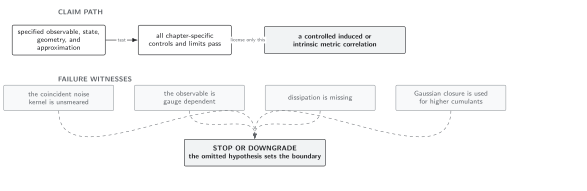
Noise positivity and causal response are independent acceptance tests for a quadratic influence action; satisfying one does not repair failure of the other. The map is schematic and not to scale.
References
Section titled “References”- Hu, B. L., and E. Verdaguer. “Stochastic Gravity: Theory and Applications.” Living Reviews in Relativity 11, 3 (2008). doi:10.12942/lrr-2008-3. Open PDF
- Martín, R., and E. Verdaguer. “Stochastic Semiclassical Gravity.” Physical Review D 60, 084008 (1999). doi:10.1103/PhysRevD.60.084008. Open PDF