

Cosmological Backreaction Benchmarks
A cosmological benchmark tests more than a mode equation. It must specify the state, renormalize the same local observable in comparable schemes, enforce conservation and the gravitational constraint, and show that the derivative and numerical expansions remain ordered. Two especially useful controls are the conformal massless limit, where particle creation disappears but the trace anomaly need not, and a massive slowly varying regime, where adiabatic subtraction can be matched to the local effective-action expansion.
Required background. Self-consistent state–geometry solutions defines the coupled problem; order reduction and runaway prescriptions controls curvature-squared branches; and adiabatic states and WKB order supplies the homogeneous ultraviolet expansion.
Helpful background. Mode-sum numerical renormalization gives practical subtraction checks, while particle creation in time-dependent backgrounds separates state-dependent production from local vacuum polarization.
A matched FLRW benchmark
Section titled “A matched FLRW benchmark”For
the scalar modes obey
The site convention is , so conformal coupling in four dimensions is . A Gaussian state is fixed by the mode data and occupation/pairing coefficients, not by the scale factor alone.
Adiabatic renormalization expands a WKB frequency and subtracts state-independent high- terms through the order required by the composite observable. In four dimensions the stress tensor requires terms through fourth adiabatic order. The resulting source must satisfy
up to numerical error, and its finite local terms must be associated with declared values of , , and the curvature-squared couplings. Parker and Fulling introduced the conserved adiabatic stress subtraction for homogeneous spacetimes (Parker and Fulling 1974, §§ II–IV).
For large compared with curvature and derivative scales, the local part of the one-loop effective action has a DeWitt–Schwinger expansion,
Varying it with
gives the same local ultraviolet structures as adiabatic subtraction after the finite gravitational couplings are matched. It does not reproduce arbitrary state-dependent nonlocal terms or nonadiabatic particle creation.
The structure map locates the benchmark’s comparison point: the two calculations must feed the same renormalized mean source and the same constrained geometry, rather than compare bare integrands.

Matched cosmological backreaction benchmark. The map is schematic and not to scale; agreement concerns conserved renormalized observables after finite-coupling translation, within the shared slow-curvature domain.
Conformal and massive limiting checks
Section titled “Conformal and massive limiting checks”For and on conformally flat FLRW, the rescaled field obeys the flat-space mode equation in the conformal vacuum. There is no state-dependent particle creation associated with that conformal mapping. Yet the renormalized stress generally has a local anomalous trace and curvature-dependent vacuum polarization. Therefore the statement “no particles” does not imply .
This is a stringent sign and subtraction test:
- the state-dependent production term must vanish in the conformal vacuum;
- the anomalous/local term must remain conserved;
- its scheme-dependent part may move under a finite counterterm, while scheme-independent anomaly data do not; and
- the Friedmann constraint must use the translated curvature coupling.
For a massive field, define
When these ratios are uniformly small in the modes dominating the observable, compare the fourth-order adiabatic stress with the metric variation of the matched local effective action. Their difference should consist of the explicitly retained state-dependent contribution and terms at the next derivative order. Failure to translate the finite couplings can produce an apparent disagreement at precisely fourth order.
Adversarial comparison protocol
Section titled “Adversarial comparison protocol”Use one physical initial two-point function and repeat the calculation while varying:
- the adiabatic reference time, transporting the state rather than re-preparing it;
- the subtraction order, while comparing only observables renormalized to a valid order;
- the mode cutoff and time step independently; and
- the finite local scheme, translating gravitational couplings at the same time.
The conserved, scheme-translated stress and backreacted geometry should agree inside a combined numerical and EFT error. Instantaneous particle numbers may change, and changing the initial time without transporting the state defines a different experiment.
As of August 2026, mathematical results for cosmological semiclassical equations establish existence, uniqueness, or asymptotics only under specified symmetry, state, mass, and coupling assumptions. Meda’s current review stresses the nonlinear and nonlocal state dependence of the source and surveys those bounded results; it does not supply a theorem for generic cosmological data (Meda 2026, §§ 1 and 4). A numerical FLRW benchmark should therefore be described as a controlled model, not evidence for generic semiclassical stability.
The failure map highlights the most revealing negative controls: an in-out source, drifting constraint, retained cutoff branch, or separately solved state and metric invalidates the benchmark even when a plotted scale factor looks smooth.
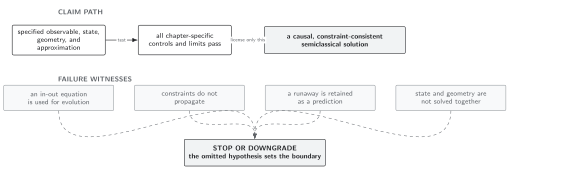
Failure conditions for cosmological benchmarks. The map is schematic and not to scale; varying adiabatic order, state preparation, finite couplings, and numerical resolution isolates different errors rather than one aggregate discrepancy.
Domain and failure conditions
Section titled “Domain and failure conditions”See the chapter domain and failure-conditions table. The conformal check assumes a conformally flat geometry and conformal vacuum; the massive comparison assumes a uniform slow-curvature expansion and a Hadamard state. Both require a conserved subtraction and compatible initial constraint. They fail at nonadiabatic crossings, infrared-enhanced regimes, derivative scales of order , or when state-dependent nonlocal terms are mistaken for local effective-action coefficients.
Exercise
Section titled “Exercise”For a conformally coupled massless scalar, explain why vanishing Bogoliubov particle production is compatible with a nonzero trace of the renormalized stress tensor.
Solution
The conformal map carries the mode equation and conformal vacuum to their flat-space forms, so there is no state-dependent mixing of positive and negative frequency modes. Renormalization of the local composite stress tensor introduces curvature-dependent terms, however, and its trace acquires the conformal anomaly. Particle production is state and basis dependent; the anomalous trace is a local renormalized observable. They test different parts of the answer.
References
Section titled “References”- Anderson, P. R., and L. Parker. “Adiabatic Regularization in Closed Robertson–Walker Universes.” Physical Review D 36 (1987): 2963–2969. DOI.
- Meda, P. “The Semiclassical Einstein Equations in Cosmological Spacetimes.” International Journal of Theoretical Physics 65 (2026): 137. DOI.
- Parker, L., and S. A. Fulling. “Adiabatic Regularization of the Energy-Momentum Tensor of a Quantized Field in Homogeneous Spaces.” Physical Review D 9 (1974): 341–354. DOI.