

Low-Energy Constraints on UV Completion
Low-energy data can constrain ultraviolet completions through unitarity, causality, analyticity, crossing, symmetry, and anomaly matching. In gravity these constraints are powerful but qualified: massless graviton exchange obstructs naive forward limits, subtraction assumptions matter, and field redefinitions decide which Wilson-coefficient combinations are observable.
Required background. Observable-specific validity contracts fixes the amplitude or causal observable; cross-expansion hierarchies supplies EFT ordering; curvature operator bases and field redefinitions supplies invariant coefficients; and EFT positivity and UV consistency supplies the dispersion argument.
Helpful background. Long-distance quantum-gravity corrections supplies universal cuts; massless exchange and infrared subtractions supplies the graviton caveat; and qualified cosmological dispersion relations supplies a nonflat comparison.
The qualified dispersion argument
Section titled “The qualified dispersion argument”For a gapped nongravitational amplitude, analyticity, crossing, unitarity, and sufficient boundedness can give a twice-subtracted relation of the schematic form
The tilde denotes known light poles and subtraction data removed according to a declared prescription. The positive spectral integral then constrains the on-shell coefficient multiplying the low-energy term. Adams and collaborators explain how wrong-sign irrelevant operators can conflict with analyticity and causal propagation Adams et al. 2006, §§2–4, Eqs. (5)–(25).
With dynamical gravity, the forward amplitude contains a massless -channel pole proportional to . The limit and the dispersion subtractions are therefore not those of a gapped theory. One may work at finite impact parameter, introduce an infrared regulator with a controlled removal, subtract a known pole under extra assumptions, or derive weakened bounds. Every choice must be included in the conclusion.
Loops add known low-energy branch cuts and logarithms. They are not arbitrary UV contamination: their discontinuities are fixed by light on-shell states and must remain on the dispersive side or be subtracted consistently. Removing a full low-energy loop amplitude and then applying a tree-level positivity statement to a scale-dependent Wilson coefficient can give a scheme-dependent sign.
Basis independence and a curvature example
Section titled “Basis independence and a curvature example”Local metric redefinitions move operators proportional to the leading Einstein equations among , , matter couplings, and higher terms. A bound belongs to an on-shell amplitude coefficient, time delay, anomaly, or other invariant combination—not to a redundant printed coefficient.
As a first application, choose a higher-curvature correction that contributes to a definite helicity amplitude after redundancies are removed. Derive the low-energy coefficient in two field-redefinition-equivalent bases, subtract the same light exchanges, and apply only the dispersion relation whose asymptotic and infrared hypotheses hold. The bound must agree between bases.
Large higher-derivative corrections to graviton three-point couplings can produce high-energy time advances unless additional higher-spin states enter at the corresponding scale. Camanho and collaborators establish this conditional causality argument in Camanho et al. 2016, §§2–5, Eqs. (2.8)–(5.18). It constrains the spectrum and scale of a completion; it does not uniquely select one microscopic framework.
Anomaly matching and exact symmetries provide complementary information because they can survive where a forward-limit bound is weak. Their coefficients constrain the infrared realization of any completion, but they likewise do not determine its entire spectrum or dynamics. Combining independent constraints is legitimate only after their dimensionality, state, and boundary assumptions are made compatible.
The structure map runs from invariant low-energy data through qualified assumptions to a bounded UV conclusion.

Low-energy UV constraints attach to invariant amplitudes or causal observables and inherit every massless-exchange, subtraction, boundedness, and field-basis qualification. Schematic; not to scale.
Massless-pole and subtraction test
Section titled “Massless-pole and subtraction test”Introduce the graviton pole explicitly, vary the infrared regulator or impact-parameter prescription, and alter allowed subtraction constants. Any sign conclusion that survives only by dropping these contributions is rejected. A weaker regulator-independent inequality may still survive and should be reported.
Symmetry and anomaly matching can supply separate exact data even when forward positivity is inconclusive. Preserve those independent constraints rather than forcing them into one dispersion argument. See the chapter’s domain and failure conditions.
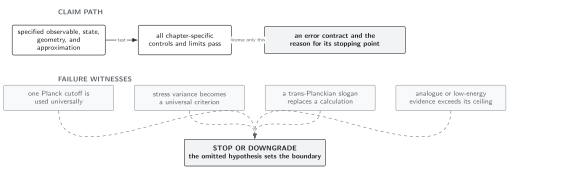
Gravitational positivity and causality statements are accepted only after massless exchange, subtractions, field redefinitions, and high-energy assumptions are made explicit and varied. Schematic; not to scale.
References
Section titled “References”- Adams, A., N. Arkani-Hamed, S. Dubovsky, A. Nicolis, and R. Rattazzi, “Causality, Analyticity and an IR Obstruction to UV Completion,” Journal of High Energy Physics 10, 014 (2006), doi:10.1088/1126-6708/2006/10/014.
- Camanho, X. O., J. D. Edelstein, J. Maldacena, and A. Zhiboedov, “Causality Constraints on Corrections to the Graviton Three-Point Coupling,” Journal of High Energy Physics 02, 020 (2016), doi:10.1007/JHEP02(2016)020.