

Adiabatic Limits and Infrared Obstructions
Compact support makes perturbative interactions local and causally controllable. Sending the switching function to one is a separate infrared problem: the limit can exist for observables in every fixed compact region while failing for a vacuum amplitude, a global state, or a zero-momentum mode. The correct conclusion depends on which of these objects is being limited and in which topology.
Required background. Local S-matrices and causal factorization supplies the algebraic local limit, and definitions of interacting fields distinguishes formal local observables from global scattering constructions.
Helpful background. In–out and in–in formulations separates vacuum amplitudes from expectation values, while EFT truncation and breakdown supplies honest error language when secular or volume terms grow.
Three limits that must not be conflated
Section titled “Three limits that must not be conflated”Let equal one on an increasing family of regions and tend pointwise to one.
- Local algebraic limit. For a fixed relatively compact , causal factorization identifies the interacting algebras defined by all sufficiently large . This needs no numerical limit of .
- State limit. A family of states transported to the stabilized local algebra may or may not converge on every local observable. Uniform positivity, clustering, spectral, or KMS estimates are additional input.
- Global amplitude or S-matrix limit. Vacuum bubbles, long-time phases, and soft modes can prevent from converging even when all normalized local expectation values do.
The first is built into perturbative algebraic QFT. The latter two are infrared theorems only under model-dependent hypotheses.
On an ultrastatic spacetime with
the free scalar spectrum is governed by
If is strictly positive and the reference state has suitable clustering, massive correlations decay and spatial/temporal switching limits can sometimes be controlled. Fredenhagen and Lindner prove an interacting KMS construction and infinite-volume control for the massive scalar in Minkowski spacetime by exploiting locality and clustering (2014, §§ 4–5). That result illustrates the necessary estimates; it is not a theorem for every ultrastatic geometry.
If has a zero mode or continuous spectrum reaching zero without sufficient decay, the free covariance contains factors and perturbative integrals can grow with the switching size. Thermal mass resummation can improve specific models, but it changes the reference split and must satisfy perturbative agreement (Drago, Hack, and Pinamonti 2017, §§ 4–5).
The construction map deliberately draws the infrared question as a dashed qualification below the final local observable. Inspect that separation: removing switching is not one of the ultraviolet or causal steps that created the local algebra.

Local construction versus global infrared completion. This schematic, not-to-scale map shows that an obstructed adiabatic limit does not undo the causal local observable already constructed.
The lower map supplies the exact downgrade rule for this page. When a mass gap, clustering estimate, or zero-mode treatment is missing, the global state or amplitude stops; the compact-region formal algebra can still pass.
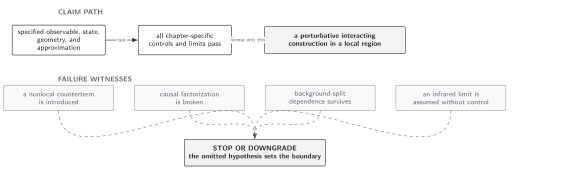
Infrared failure witness. The map is schematic and not to scale; the omitted spectral or clustering hypothesis sets the boundary between a local algebraic limit and a global interacting state.
Application: growing support on an ultrastatic spacetime
Section titled “Application: growing support on an ultrastatic spacetime”Let
where near and on a spatial ball containing a fixed region . Take a local observable supported in and the interaction .
For sufficiently large , any two switching functions agree on the causal neighborhood needed to construct . Causal factorization therefore gives canonical isomorphisms between their local representatives. Order by order, the local algebra has stabilized even if individual integral formulas still contain switching-dependent representatives.
Now consider the vacuum persistence amplitude
Its logarithm is the sum of connected vacuum diagrams. Translation-invariant or asymptotically homogeneous contributions contain an extensive factor of the switched spacetime volume,
Even in a massive theory this phase or normalization need not approach a finite number; normalized local correlators divide out the vacuum bubbles. Thus failure of is compatible with stabilization of .
For an adversarial massless test on compact , let possess a constant zero mode with . Its formal ground-state contribution to the two-point function contains
which is undefined. With an infrared regulator , loop terms acquire powers or logarithms of and of . Agreement of the construction in one fixed compact region at each finite regulator does not yield a regulator-independent global state. The strongest surviving statement is the local formal algebra, possibly restricted to observables insensitive to the zero mode, until an infrared sector, state, or resummation is supplied.
Diagnosing an infrared claim
Section titled “Diagnosing an infrared claim”The shared distinctions appear in the chapter domain and failure-conditions table. On this page, compact switching and causal stabilization license a local formal net; a global state additionally needs compatible positive limiting functionals and infrared bounds, while a global amplitude needs its own asymptotic control. The decisive tests are mass-gap or low-frequency estimates, clustering, and uniformity as support grows. Failure downgrades only the object whose extra limit was assumed: the valid result is a restricted observable sector, regulated state, or justified resummation, not rejection of the local ultraviolet construction.
| Question | Evidence needed |
|---|---|
| Does the local interacting algebra exist? | Compact switching, causal factorization, ultraviolet renormalization, and stabilization on each fixed region. |
| Does a sequence of states converge locally? | Uniform bounds on all tested local observables plus positivity and compatibility of the limiting functionals. |
| Does a vacuum or KMS state exist? | Appropriate spectrum/KMS condition, clustering or mass-gap estimates, and control of spatial and temporal limits. |
| Does a global S-matrix exist? | Asymptotic structure, soft/long-range analysis, and cancellation or dressing of infrared divergences. |
| Is a secular perturbative term harmless? | Uniform error bound or a justified resummation; small coupling alone is insufficient when is large. |
Checks and limitations
Section titled “Checks and limitations”- Normalize away vacuum bubbles before using a global amplitude to judge local correlators.
- Declare the order of temporal, spatial, mass, and regulator limits; they need not commute.
- A mass parameter does not guarantee a gap on every geometry, and a gap does not alone prove the desired clustering estimate.
- Local convergence at every fixed order does not imply convergence of the perturbation series.
- Expanding cosmologies and horizons introduce secular and state-selection issues not captured by the ultrastatic example.
Exercise
Section titled “Exercise”Why does an extensive connected vacuum diagram cancel from a normalized expectation
but still obstruct a limit of itself?
Solution
The linked-cluster expansion factorizes the numerator into the exponential of connected vacuum diagrams times the sum of connected diagrams attached to . The denominator is the same vacuum exponential. Their ratio cancels it order by order, leaving only diagrams linked to . The denominator alone retains the extensive exponential, whose phase or magnitude can fail to converge as the switched volume grows.
Related topics
Section titled “Related topics”The final page keeps the infrared problem bounded by choosing an ultrastatic background with a positive spatial operator. It combines the local ultraviolet construction, Hadamard state, curvature counterterms, and one-loop two-point function in one benchmark.
References
Section titled “References”- Drago, Nicolò, Thomas-Paul Hack, and Nicola Pinamonti. “The Generalised Principle of Perturbative Agreement and the Thermal Mass.” Annales Henri Poincaré 18 (2017): 807–868. doi:10.1007/s00023-016-0521-6.
- Fredenhagen, Klaus, and Falk Lindner. “Construction of KMS States in Perturbative QFT and Renormalized Hamiltonian Dynamics.” Communications in Mathematical Physics 332 (2014): 895–932; erratum 347 (2016): 655–656. doi:10.1007/s00220-014-2141-7.
- Hollands, Stefan, and Robert M. Wald. “Quantum Fields in Curved Spacetime.” Physics Reports 574 (2015): 1–35. doi:10.1016/j.physrep.2015.02.001.