

Particles, Local Observables, and Detector Dependence
A mode occupation, a detector excitation, and a local stress expectation answer different experimental questions. They can be computed in one field state and still disagree without contradiction. A particle claim becomes meaningful only after the basis or apparatus is named; a local energy claim additionally requires a renormalized stress tensor and an observer or flux surface.
Required background. Vacuum Ambiguity, Time Flow, and Observer Dependence supplies state and positive-frequency dependence; Particle Detectors versus Field Observables and Localized Probe and Detector Models supply the operational distinction.
Helpful background. Detector and instrument validation supplies apparatus controls; Energy Cost of Localization and Measurement explains why switching and localization can inject energy.
Four observables, four questions
Section titled “Four observables, four questions”For a normalized mode or wavepacket , a number operator
asks for occupation relative to a chosen complex structure. A Bogoliubov change of basis changes and generally changes .
A two-level detector with gap asks instead for a transition probability. To leading order in its coupling ,
where
It depends on the state through , and on the apparatus through the worldline , switching , gap, smearing, and coupling.
A local field correlator such as characterizes the state but is not itself a click probability until pulled back and integrated with an interaction. A renormalized stress tensor,
asks for local energy-momentum relative to an observer or surface. It is a composite observable with finite local curvature freedom; it is not obtained by multiplying a detector click count by .
Fulling’s analysis makes the number-operator dependence explicit Fulling 1973, pp. 2850–2862, while Unruh’s detector construction shows that a trajectory can create a response in a fixed Minkowski vacuum Unruh 1976, pp. 870–892.
First application: one quasifree state, three readouts
Section titled “First application: one quasifree state, three readouts”Take a homogeneous quasifree scalar state in Minkowski spacetime, described relative to inertial modes by occupation and, if present, anomalous covariance . For a normalized wavepacket ,
when the covariance is diagonal in that basis.
An inertial detector samples a different functional:
with extra interference terms when . Finite switching broadens the detector’s spectral window, so it does not read one pre-existing .
After subtracting the Minkowski vacuum in this simple setting, the homogeneous energy density contains
plus phase-sensitive terms for a squeezed state. This is an energy density for the declared observer, not a transition probability. The three results can correlate in a stationary long-time limit, yet their kernels, dimensions, and control errors remain different.
Adversarial detector test
Section titled “Adversarial detector test”Hold the state fixed and replace by a shorter switching, or move the detector from an inertial to a circular trajectory. The response changes because the pullback and spectral window change. The wavepacket number in the original inertial basis need not change, and the local renormalized stress tensor is still the same Minkowski-state tensor.
Calling the changed click probability a changed “particle density of the state” therefore fails. The strongest surviving statement is: this specified detector, on this trajectory and with this switching, has this excitation probability to the stated perturbative accuracy. Louko and Satz derive the curved-spacetime response for arbitrary Hadamard states with smooth switching Louko and Satz 2008, §§2–4.
Construction and failure maps
Section titled “Construction and failure maps”The construction map shows where the observables separate: number chooses a mode basis; response chooses a worldline and interaction; flux is checked through energy balance.

Mode occupation, detector excitation, and transported energy are distinct readouts of a state and geometry; the map is schematic and not to scale.
The failure map targets the central mistake on this page: an apparatus-dependent click is not automatically an invariant particle population.
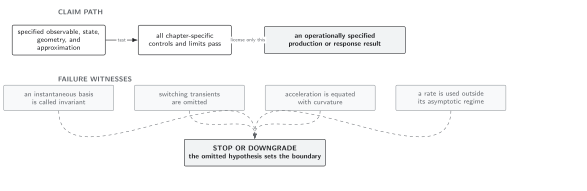
Only an operationally specified number, response, or flux is licensed; protocol dependence blocks promotion to an invariant particle density. Schematic and not to scale.
Use the canonical comparison in Domain and failure conditions. On this page the decisive checks are dimensions, basis dependence, protocol dependence, local renormalization, and energy supplied by switching or external forces.
Check your understanding
Section titled “Check your understanding”An inertial detector in the Minkowski vacuum is switched on for a short time and has nonzero excitation probability. Does this imply positive renormalized vacuum energy density?
Solution
No. Finite switching has nonzero frequency bandwidth and the external control performs work. The Minkowski-vacuum stress tensor remains zero in the standard subtraction, while the detector response can contain a transient excitation. A long stationary limit is required before interpreting a response as a stationary spectral rate.
Mode Bases, In/Out States, and Number Operators develops asymptotic counting. Detector Response Along Curved and Accelerated Worldlines develops localized response. Abstract instruments remain in Volume XIII, communication channels in Chapter 5, and local stress renormalization in Chapter 7.
References
Section titled “References”- S. A. Fulling, “Nonuniqueness of Canonical Field Quantization in Riemannian Space-Time,” Physical Review D 7 (1973), 2850–2862, DOI.
- Jorma Louko and Alejandro Satz, “Transition Rate of the Unruh–DeWitt Detector in Curved Spacetime,” Classical and Quantum Gravity 25 (2008), 055012, DOI, arXiv:0710.5671.
- William G. Unruh, “Notes on Black-Hole Evaporation,” Physical Review D 14 (1976), 870–892, DOI.