

Quasifree States and Two-Point Functions
For a real free field, a two-point distribution defines a quasifree state only if it is a positive bisolution with the canonical antisymmetric part and the correct reality and continuity properties. The field equation and commutator alone are insufficient: positivity is the condition that turns formally consistent correlation data into a state.
Required background. Covariant Algebraic Quantization and Fock Realizations fixes the CCR algebra. Complex Structures and One-Particle Spaces supplies one important source of positive covariances.
Helpful background. Operator Algebras and Positive Functionals explains positivity on a star algebra. Spectral Decomposition of Two-Point Functions provides the stationary flat-space comparison.
Two-point data and the state conditions
Section titled “Two-point data and the state conditions”Let and let be the causal propagator. Here is the site’s signed curvature coupling; in four dimensions conformal coupling is . The commutator sign is fixed by
A candidate Wightman two-point function must satisfy:
- Field equation: .
- Commutator: for real tests.
- Reality: .
- Positivity: for every complex test function .
- Continuity: is a bidistribution on the declared test-function space.
Writing
the real symmetric covariance must obey the uncertainty bound
This inequality, not smoothness or symmetry alone, encodes state positivity. Saturation in the appropriate one-particle completion characterizes a pure quasifree state; mixed quasifree states have additional covariance. These covariance and purity conditions are set out for curved-spacetime quasifree states in Kay and Wald 1991, § 2.
Some references write the Pauli–Jordan kernel as . In that notation the same statements read and ; no physical sign changes.
Wick reconstruction
Section titled “Wick reconstruction”A centered quasifree state has vanishing odd -point functions and even functions given by pairings. In particular,
This is an algebraic definition of Gaussianity. It does not say that products at coincident points are already defined; Hadamard control is still needed for local Wick powers.
For the stationary ultrastatic ground state with positive operator , the mode kernel
is a bisolution. Its antisymmetric part reproduces , and its spectral representation makes positivity manifest. These four checks must be completed before using Wick’s rule.
Smooth deformation can destroy positivity
Section titled “Smooth deformation can destroy positivity”Let be a smooth real solution and define
The added kernel is smooth, symmetric, and a bisolution, so the field equation, commutator, reality, and wavefront set are unchanged. Nevertheless,
is negative for some when is large enough. This is the adversarial test required by the page: Hadamard singular structure does not imply positivity, and a formal covariance that fails positivity is not a state.
Purity, stationarity, and admissibility
Section titled “Purity, stationarity, and admissibility”Purity concerns whether the covariance contains irreducible classical mixing. Stationarity concerns invariance under a chosen automorphism flow. Hadamard admissibility concerns ultraviolet singular directions. These properties are independent. A thermal KMS state is mixed but can be Hadamard; two distinct pure Hadamard states can differ by a smooth bisolution; a positive quasifree state can fail the Hadamard condition.
Exercise
Section titled “Exercise”Why does adding a positive kernel preserve positivity but not change the commutator?
Solution
The kernel is symmetric, so it cancels from the antisymmetric part. Its quadratic form is , so it can only increase . It generally changes purity and expectation values, showing again that the CCR do not determine the state.
Domain and failure conditions
Section titled “Domain and failure conditions”The structure map places the two-point distribution immediately after the positive algebraic state because, for a quasifree theory, that kernel carries all correlation data. Inspect the checkpoint below the Hadamard box: positivity and the canonical antisymmetric part remain independent of the smooth-difference ultraviolet test.

A bisolution becomes quasifree state data through positivity, reality, continuity, and antisymmetric part ; Hadamard regularity is a later condition. Schematic; not to scale.
The smooth nonpositive perturbation is an example of the first failure witness. It can preserve the field equation, commutator, and wavefront set while making one quadratic form negative, so only the formal kernel properties survive.
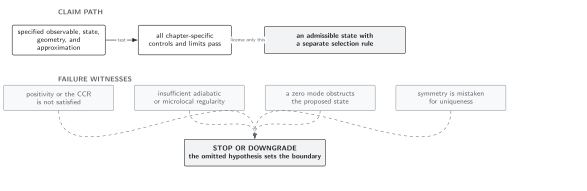
Positivity is decisive: a kernel with the correct equation, commutator, and Hadamard class is not a state if its test-function quadratic form is negative. Schematic; not to scale.
The other state classes and their decisive checks appear in Domain and failure conditions.
Related topics
Section titled “Related topics”Hadamard Parametrix and Short-Distance Structure adds ultraviolet admissibility. GNS Representations, Local Normality, and Local Quasiequivalence explains how the resulting state is represented. The rigorous continuity and existence theory belongs to Algebraic Free Fields on Curved Spacetimes.
References
Section titled “References”- Kay, Bernard S., and Robert M. Wald. “Theorems on the Uniqueness and Thermal Properties of Stationary, Nonsingular, Quasifree States on Spacetimes with a Bifurcate Killing Horizon.” Physics Reports 207 (1991): 49–136. DOI.