

Quantum Extremal Surfaces: Renormalized Semiclassical Definition
A quantum extremal surface (QES) is a codimension-two surface at which a renormalized generalized-entropy functional is stationary under admissible normal deformations. This is a semiclassical variational definition. It does not, by itself, select a global minimum, compute a radiation entropy, establish an island, or prove a Page curve.
Required background. Generalized-entropy renormalization fixes the functional; the entanglement first law controls state variations; and shape dependence supplies surface variations. Helpful background. Review gravitational replicas and the GSL.
Renormalized stationarity with complete surface data
Section titled “Renormalized stationarity with complete surface data”Let be an admissible class of smooth codimension-two surfaces. If a boundary or radiation region is involved, must include its anchors, boundary conditions, causal placement, and the specified homology constraint. For , a state , and a chosen outside algebra , define
A QES satisfies
for every allowed normal deformation that preserves the anchors and boundary conditions. In a null normal basis this may be written as vanishing quantum expansions, but the normalization of the null normals and the entropy-shape derivative must be fixed. Gauge or gravitational subregions additionally require an algebra/edge prescription; a naive Hilbert-space factorization is not assumed.
Stationarity is local. If several extrema exist, a later prescription must say whether to minimize, maximize, or choose a saddle by some other rule. Homology and anchoring are not consequences of the differential equation.
First application: displacement from a classical extremal surface
Section titled “First application: displacement from a classical extremal surface”Parameterize nearby surfaces by shape coordinates . Let be a nondegenerate classical extremum of the Einstein area, so , and define
To first order in ,
This is a reproducible model calculation when is invertible and the matter shape derivative is finite in the same scheme as the area coupling. For a higher-curvature action, replace by and use its Hessian. If has zero modes, if is singular, or if competing extrema approach within the perturbative splitting, ordinary nondegenerate perturbation theory fails.
At leading bulk quantum order, the matter entropy correction to holographic entropy was derived by Faulkner, Lewkowycz, and Maldacena 2013, §§2–3. Engelhardt and Wall introduced QESs as a proposal beyond that order Engelhardt and Wall 2015, §§2–3. The stationarity equation above is the stable semiclassical definition; the holographic minimization prescription and island applications add boundary duality and gravitational path-integral assumptions.
The structure map places QES stationarity after joint renormalization and before any holographic selection rule. Inspect the explicit separation between “extremize” and “choose an entropy.”

QES stationarity requires state, algebra, renormalization, anchors, boundary conditions, and homology data; selection among extrema is an additional rule. Schematic; not to scale.
Domain and failure conditions
Section titled “Domain and failure conditions”Use the domain table to distinguish QESs from replica saddles and GSL theorems. The result above assumes a controlled semiclassical expansion, differentiable entropy under shape deformations, and an invertible classical Hessian.
Adversarial test. Shift the finite subtraction of by a local surface functional but leave and higher-curvature couplings fixed. The gradient changes, producing a false displacement of . Transform the geometric couplings and their entropy functional in the same scheme; the stationary surface returns to its scheme-consistent position.
The failure map also marks zero modes and competing extrema: they require collective coordinates or a multi-branch analysis, not the inverse-Hessian formula.
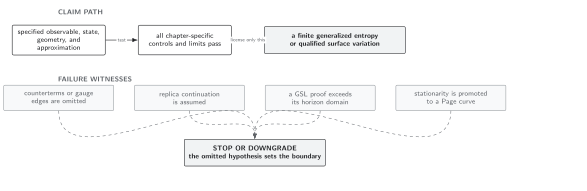
The first-order displacement is licensed only for a jointly renormalized differentiable functional near an isolated nondegenerate classical extremum. Schematic; not to scale.
Related topics
Section titled “Related topics”As of 10 August 2026, island formulas, replica-wormhole dominance, holographic entanglement-wedge reconstruction, and Page-curve calculations remain additional model- or duality-dependent applications. They must not be inferred from alone.
References
Section titled “References”- Engelhardt, N., and A. C. Wall, “Quantum Extremal Surfaces: Holographic Entanglement Entropy beyond the Classical Regime,” Journal of High Energy Physics 2015, 073 (2015), doi:10.1007/JHEP01(2015)073.
- Faulkner, T., A. Lewkowycz, and J. Maldacena, “Quantum Corrections to Holographic Entanglement Entropy,” Journal of High Energy Physics 2013, 074 (2013), doi:10.1007/JHEP11(2013)074.