

Renormalizing Stress Fluctuations and Coincident Limits
A stress covariance is naturally defined at separated points and as a distribution on pairs of test tensors. Extending it to a partial or total diagonal is a separate renormalization problem. The physically safe observable is therefore a declared smearing of the connected stress product; a formal symbol such as is not automatically a finite local variance.
Required background. The Stress-Tensor Noise Kernel fixes ; Wick Polynomials and Point Splitting supplies the one-point subtraction; and Why Local Covariant Renormalization? supplies the locality and covariance constraints on extensions.
Helpful background. Test Functions, Distributions, and Support supplies the test-function language, while Hadamard Admissibility and the Two-Point Wavefront Criterion controls products of two-point distributions.
Separated points, diagonals, and extensions
Section titled “Separated points, diagonals, and extensions”For compactly supported real symmetric test tensors and , the covariance is
When the wavefront sets satisfy Hörmander’s product criterion, the Wick contractions defining are distributions before any coincidence limit is taken. The singularity along is real physics: in four dimensions the stress tensor has mass dimension four, so its connected two-point function has short-distance degree eight. A local product at one point asks for an extension across the diagonal, not merely evaluation of an ordinary function.
In local normal coordinates, let denote one tensor component away from the diagonal. An extension with finite scaling degree exists, but if its degree is at least the codimension of the diagonal it is not unique. Two admissible extensions can differ by local terms supported on ,
where dimensional analysis bounds , and local covariance, index symmetries, conservation, and any field equation further restrict the geometric tensors . This is the curved-space version of the extension theorem used in perturbative QFT; see Brunetti and Fredenhagen 2000, §5, especially Thms. 5.2–5.3.
The map places this extension problem between the matter bi-tensor and any stochastic source. Inspect that ordering: metric dynamics cannot cure an undefined source covariance.

Distributional control precedes the influence functional and Einstein–Langevin equation; contact terms belong to the renormalized matter input, not to an after-the-fact stochastic adjustment. The map is schematic and not to scale.
First application: a doubly smeared covariance
Section titled “First application: a doubly smeared covariance”Choose a point in a convex normal neighborhood whose curvature radius is , and a smooth unit-normalized sampling profile on . For , define
where are normal coordinates and is a compact cutoff equal to one near . Contract the stress with smooth dimensionless polarization tensors and and set
The renormalized covariance
is finite for each fixed when the smearing lies in the domain of the extended distribution. In a four-dimensional Hadamard state its small- form is organized as
denotes the universal noncontact contribution fixed by the Hadamard singularity and the stress definition. Curvature, mass, and state-dependent smooth remainders enter lower noncontact orders. A contact extension contributes derivatives of the two samplers evaluated on the diagonal; derivative contact terms can scale as as well. The total leading delta-sequence coefficient is therefore prescription dependent until those contact conditions are fixed. The powers follow from and the unit-normalized four-volume sampler. They would change for worldline or null smearing.
Three checks are immediate.
- Dimensions: has mass dimension eight.
- Exchange symmetry: .
- Positivity: for the covariance defined by an actual state and admissible extension.
Conservation is checked by taking with compactly supported : integration by parts must annihilate the noncontact part and leave only the contact structure demanded by the Ward identity.
The delta-sequence test
Section titled “The delta-sequence test”Now send while keeping unit normalized. Unless the observable or state has a special cancellation, the leading term grows as . Thus the family does not converge to a finite pointwise variance. Dividing by can also be misleading when the denominator crosses zero, and a large local ratio does not by itself predict a large metric response: the retarded gravitational kernel and the physical sampling scale still matter.
A 2026 proposal by Perez and Sudarsky uses an operator-product expansion to define renormalized coincident stress products for suitable Hadamard states and studies a local semiclassicality criterion Perez and Sudarsky 2026, eqs. (4)–(10), (19), and Appendix A. As of the evidence cutoff 10 August 2026, this accepted Physical Review Letters result is a current OPE-based prescription and model analysis. It does not establish a universal, prescription-free pointwise random variable, nor does its local ratio replace a smeared gauge-invariant metric-response calculation. That ceiling is especially important because finite local extension terms and the observable’s sampling dimension remain part of the definition.
Domain and failure conditions
Section titled “Domain and failure conditions”The chapter comparison table places this page at the distributional input boundary. A licensed result names the state class, the diagonal being extended, the test-function space, the finite local terms, and the Ward identities imposed. Separated supports avoid the total coincidence problem but not necessarily every partial diagonal in a four-point function. Boundaries and non-Hadamard states require additional analysis.
The failure map’s unsmeared-coincidence branch is decisive here: shrinking a sampler exposes the singular scaling rather than creating a regulator-independent number.
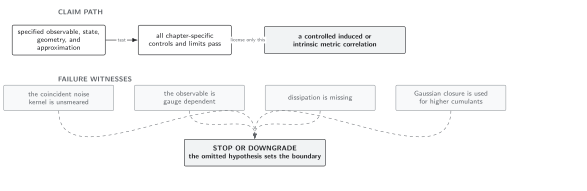
Finite width, state regularity, and a specified contact prescription license the covariance; the zero-width limit generally forces a downgrade from “pointwise fluctuation” to “distributional or smeared observable.” The map is schematic and not to scale.
Exercises
Section titled “Exercises”Let in flat four-dimensional spacetime and suppose the leading stress covariance is homogeneous of degree . Show that the doubly smeared covariance scales as .
Solution
Write the covariance as . Set and . The measures contribute , the two samplers , and . The result is therefore times an -independent distributional pairing.
References
Section titled “References”- Brunetti, R., and K. Fredenhagen. “Microlocal Analysis and Interacting Quantum Field Theories: Renormalization on Physical Backgrounds.” Communications in Mathematical Physics 208, 623–661 (2000). doi:10.1007/s002200000170. Open PDF
- Perez, A., and D. Sudarsky. “Renormalization of the Quantum Stress Tensor Fluctuations and the Limits of Semiclassical Gravity.” Physical Review Letters, accepted 1 June 2026. doi:10.1103/jvj4-hk16. Open PDF