

Complex Structures and One-Particle Spaces
A compatible complex structure packages a positive-frequency choice without assuming a global mode basis. Starting from the real symplectic space of classical solutions, it defines a positive real covariance, a complex one-particle inner product, and hence a Fock representation. The construction works only when compatibility and positivity both hold; a map with is not enough.
Required background. Covariant Symplectic Structure and Conserved Inner Products supplies the real solution space and symplectic form. Covariant Algebraic Quantization and Fock Realizations supplies the CCR algebra being represented.
Helpful background. Operator Algebras and Positive Functionals clarifies the relation between state and representation. Unbounded Operators, Domains, Closure, and Adjoints is useful for the spectral square roots below.
Compatible complex structures
Section titled “Compatible complex structures”Let be the real space of smooth solutions with suitable support, modulo any gauge degeneracy. A compatible complex structure is a real-linear map such that
for nonzero . The first condition supplies multiplication by ; the second preserves the canonical structure; the third is the physical positivity condition. With the convention
completion of the image of the one-particle map gives the one-particle Hilbert space . The symmetric Fock space then realizes the field algebra. Overall factors can be shifted between and the field normalization; positivity and the CCR fix the invariant content.
On the complexified solution space, the projectors select the eigenspaces. Calling one eigenspace “positive frequency” is a convention tied to the sign chosen for and ; the induced two-point function provides the check.
Ultrastatic scalar field
Section titled “Ultrastatic scalar field”Consider
where is positive and self-adjoint on the chosen domain. The coupling follows the site’s signed convention , so conformal coupling in four dimensions is . Write Cauchy data as and
The stationary ground-state complex structure is
It squares to , preserves , and yields
This is the declared first application: the positive spectral square root of produces both the frequency splitting and the one-particle norm. Zero modes require separate treatment because is then undefined; boundary conditions enter through the self-adjoint domain of . The stationary quasifree construction and its spectral hypotheses are developed in Kay and Wald 1991, §§ 2–3.
The adversarial compatibility test
Section titled “The adversarial compatibility test”Three near misses expose the independent conditions.
- Replacing by an operator that is not positive can preserve while making indefinite.
- A positive that does not respect the stationary spectral decomposition can define a Fock state, but not the claimed stationary ground state.
- A map defined only on formal modes may fail to be densely defined or continuous on the classical phase space.
Thus “symplectic-compatible” does not imply “positive,” and “positive” does not imply “stationary.” In a time-dependent spacetime, evolution carries to another complex structure ; equality with is an extra invariance condition.
Check: oscillator reduction
Section titled “Check: oscillator reduction”For an eigenmode with , the construction reduces to
the standard harmonic-oscillator norm. This exact reduction checks the signs, dimensions, and positivity.
Domain and failure conditions
Section titled “Domain and failure conditions”A complex structure acts near the beginning of the construction path: it converts real symplectic data into a positive covariance and one-particle space. The map makes clear that compatibility, positivity, and the CCR must be checked before the resulting Fock realization is tested for Hadamard form or given a physical preference.

The complex structure licenses a one-particle realization only after positivity and symplectic compatibility; it does not by itself license Hadamard or ground-state status. Schematic; not to scale.
The failure map separates two adversarial cases. If is negative, statehood fails at the first witness; if is positive but does not commute with the stationary evolution, the Fock state survives but the ground-state selection claim does not.
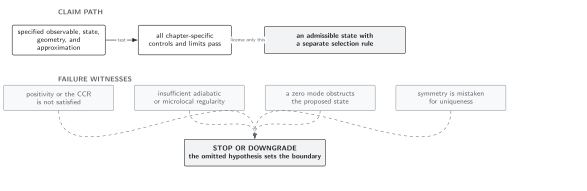
Different failed hypotheses produce different downgrades: positivity controls existence as a state, while commutation with the flow controls stationary selection. Schematic; not to scale.
For the chapter-scale comparison, see Domain and failure conditions.
Related topics
Section titled “Related topics”Quasifree States and Two-Point Functions expresses the same state directly as a bidistribution. Bogoliubov Transformations and Unitary Implementability compares two choices of . Proof-level algebraic constructions continue in Algebraic Free Fields on Curved Spacetimes.
References
Section titled “References”- Kay, Bernard S., and Robert M. Wald. “Theorems on the Uniqueness and Thermal Properties of Stationary, Nonsingular, Quasifree States on Spacetimes with a Bifurcate Killing Horizon.” Physics Reports 207 (1991): 49–136. DOI.