

Expansion History, Percolation, and Completion
Nucleation, percolation, and completion answer different questions. A first bubble can appear while almost all space remains false vacuum; converted regions can form a connected network while the physical false-vacuum volume still grows; and a transition can fail to complete during vacuum domination even when its converted fraction increases. The calculation must evolve the rate, scale factor, wall trajectory, and reheating together.
Required background. Thermal nucleation in an expanding universe supplies the versioned local rate. Percolation, reheating, and completion supplies the stochastic-geometry framework, and bubble growth and wall friction supplies the wall input.
Helpful background. Real-time vacuum decay clarifies state-dependent rates, while mode matching across cosmological eras supplies later transfer through changing backgrounds.
False-vacuum fraction from expanding bubbles
Section titled “False-vacuum fraction from expanding bubbles”Let be the nucleation rate per proper false-vacuum volume and the physical wall speed relative to the cosmological frame. Neglecting the critical radius for the moment, a bubble born at has comoving radius
For homogeneous Poisson nucleation, the probability that a comoving point remains in the false phase is
A non-negligible initial radius is included inside with the appropriate scale-factor conversion. Guth and Weinberg derive this expanding-background exclusion volume and its survival interpretation (Guth and Weinberg 1983, Eqs. (2.1)–(2.8)).
The mean converted fraction is
It is not the probability of a connected converted cluster. A quoted percolation time requires a specified continuum-percolation model and threshold. For uncorrelated overlapping spheres, a frequently used benchmark is , or , but wall correlations, inhomogeneous nucleation, finite volume, and nonspherical growth move it. The threshold is an operational convention to vary, not a universal constant.
Three event times
Section titled “Three event times”A reproducible history reports at least:
- nucleation onset: a declared expected event count reaches unity in a specified comoving or Hubble-sized region;
- percolation: the chosen connectivity statistic crosses its declared threshold;
- completion: the residual false phase becomes both sufficiently rare and physically shrinking.
The physical false-vacuum volume in a fixed comoving region is proportional to
Therefore
A necessary local completion condition is for a sustained interval. It is not sufficient by itself: one must also reach a small declared , avoid a later reversal, and verify that reheating or wall slowing does not invalidate the inputs.
In a vacuum-dominated de Sitter benchmark with constant , constant , and a luminal wall,
At late times,
so shrinking physical false-vacuum volume requires
This threshold belongs to the idealized constant-, constant-rate, luminal-wall slicing. It is a sharp adversarial check for a numerical implementation, not a general theorem about a time-dependent transition or a measure-independent statement about eternal inflation.
Coupled expansion and reheating
Section titled “Coupled expansion and reheating”During strong supercooling, need not be monotonic and radiation domination can fail. Evolve in time:
with an explicit energy partition among false vacuum, true phase, plasma, scalar gradients, and bulk wall motion. A source equation such as
is meaningful only when is derived from that partition; adding latent heat independently to both and the phase-weighted equation of state double counts energy.
Megevand and Ramírez analyze nucleation and bubble growth when strong supercooling makes the usual rapid-transition approximations unreliable (Megevand and Ramírez 2017, §§ 2–4). Their controlled models illustrate the need to solve the history, not a universal prescription for every plasma.
Threshold and covariance adversarial test
Section titled “Threshold and covariance adversarial test”Run the supplied joint rate–wall ensemble through a vacuum-dominated interval. For every joint sample:
- compute the first-event distribution, , , and ;
- evaluate connectivity at two justified percolation thresholds;
- vary the wall prescription within its correlated uncertainty;
- verify the Friedmann constraint and total-energy residual.
Reject a “completed” label if it disappears under a plausible threshold, if it relies on independently combining mutually correlated extreme rate and wall samples, or if is still increasing. Report such a case as nucleated, percolating under a stated model, or incomplete—whichever is actually supported.
The structure map displays the three event times. Inspect how bubble growth and overlap intervene between microscopic nucleation and any baryon or gravitational-wave output.

Nucleation, percolation, and completion in an evolving universe. The diagram is schematic and not to scale; wall motion, reheating, and expansion determine distinct event times.
The failure map blocks common shortcuts. Inspect the separate stops for one-bubble onset, threshold sensitivity, vacuum domination, correlated wall uncertainty, and energy nonconservation.
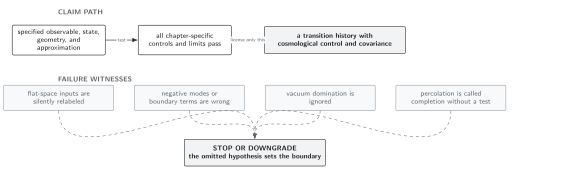
Failure conditions for transition completion. The diagram is schematic and not to scale; increasing converted fraction is compatible with increasing physical false-vacuum volume.
These tests refine the chapter’s domain and failure conditions. Only accepted histories should be handed to baryon-yield propagation or gravitational-wave transfer.
Exercise
Section titled “Exercise”Derive the late-time de Sitter completion threshold above.
Solution
For and ,
Hence . Differentiating the integral for and taking gives . Since , physical false volume shrinks only if .
References
Section titled “References”- Guth, A. H., and E. J. Weinberg. “Could the Universe Have Recovered from a Slow First-Order Phase Transition?” Nuclear Physics B 212 (1983): 321–364. DOI.
- Megevand, A., and S. Ramírez. “Bubble Nucleation and Growth in Very Strong Cosmological Phase Transitions.” Nuclear Physics B 919 (2017): 74–109. DOI. Open PDF.