

Large-N Quantum–Stochastic Correspondence
For many identical quantum matter fields, the Einstein–Langevin covariance reproduces a precise quantum object: the leading nontrivial large-N symmetrized two-point function of linear, gauge-invariant metric perturbations about one semiclassical saddle, provided the intrinsic initial covariance is matched as well. This correspondence does not supply the metric commutator, out-of-time-order correlators, nonlinear operator algebra, or a complete graviton state.
Required background. Einstein–Langevin Dynamics fixes the stochastic normalization; Large-N, Loop, and ℏ Hierarchies separates matter and metric loops; and Large-N Limits and Normalizations supplies the scaling limit.
Helpful background. Subleading Corrections, Double Scaling, and Nonuniform Limits warns against exchanging limits, while Connected Correlators and Cumulants fixes connected counting.
Scaling with the number of matter fields
Section titled “Scaling with the number of matter fields”Let independent, identically prepared matter fields couple to one metric. Take
The total mean stress and total noise kernel scale as
because connected cross-correlations vanish for independent species. Hence , while
Physical metric fluctuations have amplitude and covariance . Matter-loop polarization remains in the leading response operator because is fixed; internal metric loops are suppressed. This is a matter large-N expansion, not the color expansion of a gauge theory.
The structure map locates large-N matching after gauge projection and the intrinsic/induced split. Inspect that ordering: matching a bare covariance or omitting the initial metric state would not establish the claimed correspondence.

The correspondence concerns a selected symmetrized linear observable at leading nontrivial order in , after initial data, causal response, and gauge projection have been matched. The map is schematic and not to scale.
First application: one linear perturbation mode
Section titled “First application: one linear perturbation mode”Let be a gauge-invariant linear metric mode. At leading nontrivial order, its quantum solution can be written schematically as
where the dressed contains the leading matter polarization, denotes initial metric data, and the stress operator is centered. Assuming the chosen initial preparation has no connected metric–matter cross term, its symmetrized connected correlator is
Choose the Einstein–Langevin initial random data to have covariance and the stochastic stress source to have covariance . The stochastic two-point function is then term-by-term identical:
If initial matter–metric correlations are present, the matching cross term must be included on both sides. The absolute remainder assumes a regular expansion; secular enhancement or a critical response can make the large-N limit nonuniform. The intrinsic/induced proof and its stability implications are given in Hu, Roura, and Verdaguer 2004, §§II–IV. A cosmological linear example matching the usual quantized perturbation result appears in Roura and Verdaguer 2008, §§III–IV.
The comparison has four mandatory controls:
- the same semiclassical saddle and renormalized response kernel;
- the same initial metric covariance and mixed initial data;
- the same gauge-invariant smearing and operator ordering;
- a time and momentum range in which corrections remain smaller than the retained term.
What the classical process cannot return
Section titled “What the classical process cannot return”For classical stochastic variables,
The quantum commutator is generally nonzero. It is related to a separately computed retarded response, not encoded in the stochastic covariance itself. Likewise,
depends on operator ordering and cannot be inferred from a classical two-point process. Even in a Gaussian quantum state, a covariance plus a separately supplied symplectic form is needed to specify the state; covariance alone is insufficient. Therefore a successful large-N comparison licenses the displayed anticommutator, not a graviton Hilbert space or full density matrix.
Domain and failure conditions
Section titled “Domain and failure conditions”The chapter comparison table places this result in the leading large-N quantum row. It requires independent or otherwise controlled species correlations, fixed, one stable saddle, weak linear perturbations, matched initial data, and gauge-invariant smeared observables. Graviton/ghost loops, nonlinear metric vertices, higher stress cumulants, and nonuniform late-time limits belong to corrections.
The failure map’s final branch is the adversarial test: ask the stochastic model for a commutator or out-of-time-order correlator. Its inability to answer is a boundary of the approximation, not a numerical defect.
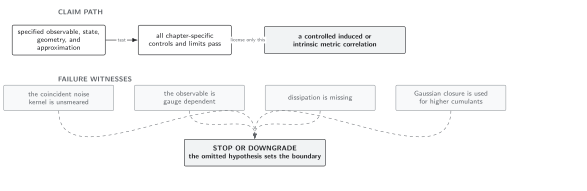
Large-N stochastic agreement is ordering- and observable-specific; extending it to the full quantum metric algebra exceeds the controlled result. The map is schematic and not to scale.
Exercises
Section titled “Exercises”Verify the scaling of the induced covariance.
Solution
Independence gives . Since , the factor multiplying the response product is . The dressed response is when is fixed, so the covariance is .
References
Section titled “References”- Hu, B. L., A. Roura, and E. Verdaguer. “Induced Quantum Metric Fluctuations and the Validity of Semiclassical Gravity.” Physical Review D 70, 044002 (2004). doi:10.1103/PhysRevD.70.044002. Open PDF
- Roura, A., and E. Verdaguer. “Cosmological Perturbations from Stochastic Gravity.” Physical Review D 78, 064010 (2008). doi:10.1103/PhysRevD.78.064010. Open PDF