

Evidence, Analogue Systems, and Astrophysical Claim Limits
Experiments can validate a platform Hamiltonian, a quantum state, an observable correlation, or a complete communication task without thereby confirming the corresponding gravitational phenomenon. This page fixes durable limits of interpretation. Its current-evidence statements were checked through 10 August 2026; later experimental priority or replication claims belong in a dated research record.
Required background. Relativistic Protocols, Clocks, Encoding, and Channel Tomography supplies the reproducible protocol. Detector and Instrument Validation supplies systematics and calibration. Claim–Evidence Records, Replication, and Retraction Handling supplies evidence maintenance.
Helpful background. Relativistic Communication Protocols: Assumptions and Status separates proposals, demonstrations, and deployments. Vacuum Entanglement Harvesting identifies the detector-model target. Bell Nonlocality with Quantum Fields distinguishes entanglement, Bell violation, and correlation.
Evidence classes and their ceilings
Section titled “Evidence classes and their ceilings”Use the narrowest class supported by the measurement.
- Theorem or model calculation. Equations plus stated hypotheses establish a result inside a mathematical model. A detector-channel capacity or harvesting negativity computed on a curved background is not an observation.
- Kinematic or Hamiltonian analogue. A laboratory system reproduces a wave equation, dispersion relation, horizon, or scattering matrix. This tests the platform and the mapped sector, not Einstein dynamics or an astrophysical black hole.
- Quantum analogue measurement. The platform additionally prepares or verifies nonclassical states, correlations, entanglement, or quantum statistics for mapped observables. The evidence remains about the analogue system unless a universality argument with controlled alternatives is supplied.
- Gravitationally deployed quantum protocol. Quantum systems traverse or compare genuinely different gravitational potentials or proper times, and the protocol isolates a relativistic contribution. This tests quantum theory on a classical gravitational background, not quantization of gravity.
- Astrophysical observation. Radiation or correlations are observed from an astronomical source and competing emission, propagation, and detector models are controlled. Even this would need a defined encoding and decoder before becoming evidence for a communication capacity.
These classes are not a single ladder of “realism.” An analogue platform may test high-quality quantum correlations while an astronomical observation tests only classical propagation. The claim must follow the measured observable.
Classifying an analogue-horizon experiment
Section titled “Classifying an analogue-horizon experiment”For any analogue measurement, record six items.
Reproduced dynamics. State the microscopic platform Hamiltonian and the approximation that yields the effective metric or horizon. Record dispersion, dissipation, finite size, pump depletion, and any external drive.
Prepared state. Distinguish classical stimulation, thermal or coherent input, spontaneous vacuum input, heralded single particles, and reconstructed entangled pairs.
Measured observable. Name spectra, occupation numbers, density–density correlations, , a covariance matrix, an entanglement witness, or a Bell statistic. “Hawking radiation” is an interpretation, not an instrument readout.
Channel task. Identify sender encoding, receiver algebra, decoder, resource constraint, and error metric. If these were not implemented, no channel capacity or transfer fidelity was measured.
Controls. Include no-horizon and no-pump fixtures, dispersion and temperature calibration, detector efficiency, background subtraction, alternative nonlinear processes, uncertainty, and independent repetitions.
Extrapolation. State which conclusion requires universality beyond the platform. An effective acoustic or optical metric does not reproduce the semiclassical Einstein equation, black-hole microstates, or the information-loss problem.
The distinction is supported by the current comprehensive analogue-gravity review, which treats analogue systems as controlled realizations of effective geometries and surveys platform-specific Hawking-like measurements Barceló, Liberati, and Visser 2026, § 3.8.
Worked evidence classification: stimulated optical emission
Section titled “Worked evidence classification: stimulated optical emission”A 2026 optical-fiber experiment used spontaneous four-wave mixing to herald a single input photon and a Kerr pump pulse to create an effective horizon and frequency-shifted output. It measured spectral dependence, intensity scaling, and a heralded second-order correlation, reporting for the analogue-Hawking output Felipe-Elizarraras et al. 2026, § “Quantum nature,” Figs. 5–7.
The supported classification is:
- Hamiltonian/kinematic evidence: agreement of frequency conversion with the dispersive optical-horizon model over the scanned pump parameters;
- state/observable evidence: a heralded, single-photon-dominated stimulated output, with measured nonclassical photon statistics;
- channel evidence: a platform-specific conversion process with identifiable input and output optical modes, but not a full curved-spacetime coding or capacity experiment;
- not established: spontaneous vacuum pair production in that setup, Hawking-partner entanglement, radiation from a gravitational event horizon, black-hole backreaction, or information recovery.
Earlier Bose–Einstein-condensate experiments reported density-correlation evidence and an entanglement analysis for spontaneous analogue emission Steinhauer 2016, pp. 959–965. That is quantum analogue evidence conditioned on the condensate model, reconstruction, and systematics. It is neither direct astrophysical Hawking detection nor a detector-based harvesting experiment.
Gravitational and space-network evidence
Section titled “Gravitational and space-network evidence”Satellite experiments have distributed entangled photons over long free-space links Yin et al. 2017, pp. 1140–1144. They establish space-based entanglement-distribution technology under measured loss, pointing, atmospheric, and detector conditions. Unless a curvature- or redshift-dependent term is independently resolved against those systematics, they do not measure a curved-QFT channel correction.
Conversely, a 2025 proposal shows how entangled clock networks could make nonlocal observables sensitive to different proper times Borregaard and Pikovski 2025, §§ III–VI. Its type is a theoretical protocol and feasibility analysis, not completed experimental evidence. If implemented, it would test quantum coherence on a classical curved background; it would not by itself demonstrate quantum gravitational degrees of freedom.
As of the stated cutoff, no direct observation of Hawking radiation from an astrophysical black hole has supplied a communication channel, harvesting witness, or information-theoretic capacity. Classical gravitational-wave confirmation of horizon-scale geometry or black-hole area behavior is valuable gravitational evidence but does not fill that quantum-protocol gap.
The dispersion-agreement adversary
Section titled “The dispersion-agreement adversary”Suppose a classical water-wave or optical experiment reproduces the predicted positive- and negative-frequency branches of an analogue dispersion relation. Calling that “confirmation of gravitational quantum information” skips at least:
- quantum state preparation or vacuum-noise identification;
- a quantum correlation, entanglement, or nonclassicality witness;
- localized sender and receiver operations;
- a causal channel reconstruction;
- coding, energy, and error constraints;
- a universality argument connecting the platform observable to a gravitational system;
- exclusion of platform-specific nonlinear, thermal, and instrumental alternatives.
The strongest surviving claim is agreement with the analogue scattering or dispersion model in the tested range. If quantum statistics were also measured, the claim can rise to a quantum analogue result—but still not to gravitational experimental confirmation.
Domain, limits, and maps
Section titled “Domain, limits, and maps”The chapter’s comparison is Domain and failure conditions. Evidence categories can change when new controls, independent repetitions, or reanalyses appear; that is why dated status belongs outside this durable classification. Null results constrain only the tested coupling, state, observable, parameter range, and sensitivity.
The structure map places experimental evidence after a fully specified protocol and observable. Inspect the task stage: a platform correlation is not automatically a communication result.

Analogue dynamics, quantum-state evidence, gravitational deployment, and task-level communication evidence are distinct claim types with distinct controls. Schematic; not to scale.
The failure map identifies unsupported extrapolation. A missing encoding, access algebra, resource model, or causal separation prevents a platform measurement from becoming a broad information claim.
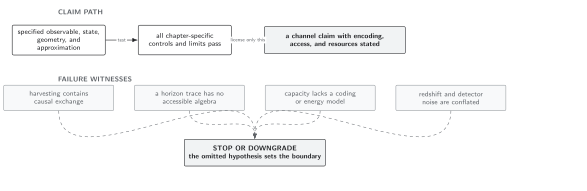
Agreement with an analogue dispersion relation or nonclassical platform statistic licenses only the corresponding mapped observable, not astrophysical Hawking radiation or information transfer. Schematic; not to scale.
Related topics
Section titled “Related topics”Relativistic Protocols, Clocks, Encoding, and Channel Tomography defines the measurements needed for a channel claim. Dated replication, correction, and priority questions belong to the research evidence record. Bell Nonlocality with Quantum Fields develops the stronger Bell-test requirements.
References
Section titled “References”- Barceló, Carlos, Stefano Liberati, and Matt Visser. “Analogue Gravity.” Living Reviews in Relativity 29 (2026): 2. DOI.
- Borregaard, Johannes, and Igor Pikovski. “Testing Quantum Theory on Curved Spacetime with Quantum Networks.” Physical Review Research 7 (2025): 023192. DOI. Open PDF.
- Felipe-Elizarraras, Rodrigo, Hector Cruz-Ramirez, Karina Garay-Palmett, Alfred U’Ren, and David Bermudez. “Measurement of Analogue Hawking Radiation Stimulated by a Single Photon.” Nature Communications 17 (2026): 7012. DOI.
- Steinhauer, Jeff. “Observation of Quantum Hawking Radiation and Its Entanglement in an Analogue Black Hole.” Nature Physics 12 (2016): 959–965. DOI. Open PDF.
- Yin, Juan, Yuan Cao, Yu-Huai Li, Sheng-Kai Liao, Liang Zhang, Ji-Gang Ren, Wen-Qi Cai, et al. “Satellite-Based Entanglement Distribution over 1200 Kilometers.” Science 356 (2017): 1140–1144. DOI.